
The Compact Conquest: How neighbourhood malls are reimagining urban retail

For years, Indian retail was measured in size; the bigger the mall, the bigger the bragging rights. But walk through Delhi-NCR today and you’ll notice something changing. Compact neighbourhood malls are emerging in areas such as Noida Extension, Dwarka, and Gurugram’s new sectors and high-density areas, designed to seamlessly integrate into daily life. The idea is simple. People no longer want to drive an hour, hunt for parking, and spend half a day in a mall just to pick up groceries and catch a film. Post-pandemic habits have reinforced this. Shoppers prefer retail that sits closer to home, within a 10–15-minute drive. Knight Frank’s latest study highlights that dense micro-markets are now the primary drivers of retail growth. These malls usually range between 50,000 and 200,000 sq ft with a high-quality supermarket at the centre, surrounded by a few F&B brands, salons, wellness clinics, a play zone or a small multiplex, plus essential services like banks and pharmacies. It’s enough to keep footfalls steady throughout the week. CBRE data shows retail leasing in India shot up nearly 50% in 2023, and a significant chunk was driven by new malls of this scale. According to a recent report by Cushman & Wakefield, retail leasing in high streets across Delhi-NCR jumped a massive 57% year-on-year in Q1 2025, accounting for 61% of the region’s total leasing activity. Gurugram led the way, followed by Noida and Delhi. Much of it was driven by neighbourhood malls. Pankaj Jain, Founder & CMD, SPJ Group, says, “Neighbourhood malls are redefining the urban retail landscape by combining convenience with community. He notes that design and layout play an integral role in a retail project’s success: “Developers are realising that the format must look and feel different from the boxy malls of the 2000s. Curated is the keyword. People don’t want 200 stores. They want a clean, walkable space where the mix of tenants feels right. With evolving lifestyles and a growing preference for hyperlocal experiences, we are seeing increasing fondness for these formats as they deliver both footfall consistency and a sense of belonging for residents. For developers, this is not just about building retail spaces, but about creating vibrant social hubs that enhance liveability. In our project design, we are particular in designing them for everyday use, but with enough character to become the go-to social spot. That’s how you build loyalty.” Arjun Gehlot, Director, Ambience Malls, says, “The ability to tailor tenant mix is another edge. As cities like Gurugram continue to evolve, malls here are shaping up as cultural and social hubs that define urban living. The city’s purchasing power now rivals that of Delhi, which makes it an attractive destination for both consumers and brands. This has created a natural pull for top international retailers who now see Indian malls as the most strategic entry point to connect with an aspirational and diverse consumer base. Global fashion and lifestyle names coexisting alongside national brands and even familiar neighbourhood favourites offer a holistic experience that feels both world-class and rooted in community.” Ajendra Singh, VP, Sales & Marketing, Spectrum@Metro, says, “For developers, the case is practical as much as it is strategic. Smaller malls don’t tie up capital for years, and leasing cycles are quicker. More importantly, they tap into a ready-made catchment of residents. Post-pandemic behaviour has made this model stronger. People want F&B and essential retail right next door. For us, it creates value on both sides, our housing projects get a retail anchor, while the mall itself finds tenants faster and delivers steady yields.” Across India, from Bengaluru’s Whitefield to Mumbai’s suburbs, similar stories are playing out. But NCR’s density and township-led growth may make it the testing ground for the model. Analysts point out that as the region sprawls further outward, compact retail will be the backbone of these self-contained ecosystems. So while the big malls will always have their place on the weekends, it’s the compact neighbourhood centre that is fast becoming the workhorse of urban retail. In NCR, especially, that shift is visible every time a new township opens, and almost immediately, a neighbourhood mall rises to complete it.
Nexus Select Trust’s Retail Revolution

Behind the Scenes of India’s Largest Consumption Platform – Vision, Velocity, and the Next Phase of Growth At the Capital Markets Day hosted by Nexus Select Trust, a spirited fireside chat brought together three of India’s most influential minds in real estate: Anuj Puri, Chairman of Anarock Group; Tuhin Parikh, Senior Managing Director at Blackstone; and Arjun Sharma, Vice Chairman of Nexus Select Trust and Chairman of Select Infrastructure. With humour, history, and high conviction, the trio peeled back the layers of what powers India’s largest retail consumption platform. From a Mall to a Movement: The Genesis of Nexus Tuhin Parikh shared the strategic roots of Nexus Select Trust with characteristic candour: “There wasn’t some grand vision. Blackstone believes in doing few things, but going deep and doing them at scale. That was the thinking.” Having seen the durability of location-led retail through his early days, Parikh was convinced that retail in India could be resilient and scalable. The first step came in 2016 with the acquisition of Amritsar’s AlphaOne mall. What followed was a blistering pace of platform-building, thanks to a core belief: great assets need great operators. The Power of Partnership For Arjun Sharma, aligning Select CITYWALK — India’s most iconic mall — with Nexus was both strategic and philosophical. “When you have a partner like Blackstone, with deep respect for colleagues and partners, the decision is easy. Nexus’s platform allowed us to monetize while becoming part of something much larger. And Nexus’s playbook on acquisitions is just stellar,” Sharma said. He underscored that consumption centres like Select are no longer just malls, but emotion-led ecosystems with marketing, footfall management, and lifestyle curation at their core. Buy or Build? A Case for Strategic Acquisition When asked about the ‘build vs. buy’ dilemma, Sharma noted: “If you’re looking at a 10 year return window, development and acquisition yield roughly the same IRR. But acquisitions de-risk the timeline and regulatory uncertainty. And with our team’s expertise, we can turn around underperforming malls in 12-18 months with 20%+ IRR gains.” He cited Nexus’s recent acquisition of Vega City Mall in Bangalore and its exponential post-acquisition growth as proof of the model. Why India’s Retail Real Estate is Different Parikh highlighted the distinctiveness of Indian retail from its global peers. “In the West, malls are utilitarian. In India, they’re cultural hubs. Our malls are more infill, experience-driven, and cashflow positive. This isn’t just about square feet. It’s about purpose,” he said. He also pointed out that while global investors were wary of retail post-2010, India’s demographic dividend and urban consumption behaviour presented a compelling counter-narrative. Why REITs are the Future As a pioneer of REITs in India, Parikh believes their best days are ahead. “REITs offer liquidity, transparency, tax-free dividend flows, and are easier for generational wealth transfer. No small office or shop can compete with that,” he said. Currently there are four REITs with 1 more launching soon, Blackstone is all-in on this asset class. Tier 2–Tier 3: India’s Real Growth Engines Sharma highlighted how smaller cities are outperforming expectations. “Bhubaneswar’s Esplanade Mall has seen double digit CAGR over 5 years. Ludhiana sells the most Mercedes per capita. We’re seeing Zara and H&M keen to enter these markets through our platform,” he said. Parikh recalled initial doubts during the Bhubaneswar deal, only to watch the asset become one of the top performers in the Nexus portfolio. The Most Involved Asset Class While Parikh manages offices, hotels, logistics and retail assets, he admits retail is the most engaging. “Logistics is passive. Hotels are intensive but third-party managed. Retail? It’s a living animal. You innovate daily — from events to marketing revenue to tenant mix. Five years ago, we had zero in marketing income. Today, it’s over Rs. 100 crore,” he revealed. Sharma added: “Which other business gives you 75% gross operating profit? And that too with multiple income streams beyond rent — from events to brand launches to ad revenue.” Long-Term Parentage and the Future of Nexus Will Blackstone remain a long-term parent? “That depends,” said Parikh. “But whether we hold it forever or not, the foundation is built to last. The moat is real, the team is unmatched, and innovation is constant. Anyone who tries to replicate this will have to go through years of pain we’ve already endured.” Sharma added: “We’ve only increased our shareholding since listing. And I’ve told Tuhin, I want him to be Chairman forever.” Rapid Fire with Retail Titans One city ready to explode? “Gurgaon, Navi Mumbai, and southern tech hubs,” said Sharma. One global brand you want tomorrow? “We brought Apple. Next? Harrods or Galeries Lafayette.” One Indian mall outside Nexus you admire? “Phoenix Parel, for their ability to innovate and hold the moat for decades,” said Parikh. Biggest strength of Nexus? “Energy,” said Parikh. “People,” added Sharma. Conclusion: The Nexus Thesis If one word defined the chat, it was “passion.” Whether it’s Blackstone’s scale philosophy, Sharma’s wisdom garnered by running India’s most successful mall, or Nexus’s exponential ambitions, one thing is clear: India’s retail renaissance is being shaped not just by capital and catchments, but by conviction. And in that conviction, Nexus Select Trust is not just running malls. It’s building India’s consumption future.
Group 108’s 23-Acre Grandthum gets part CC; 1300 customers to receive possession
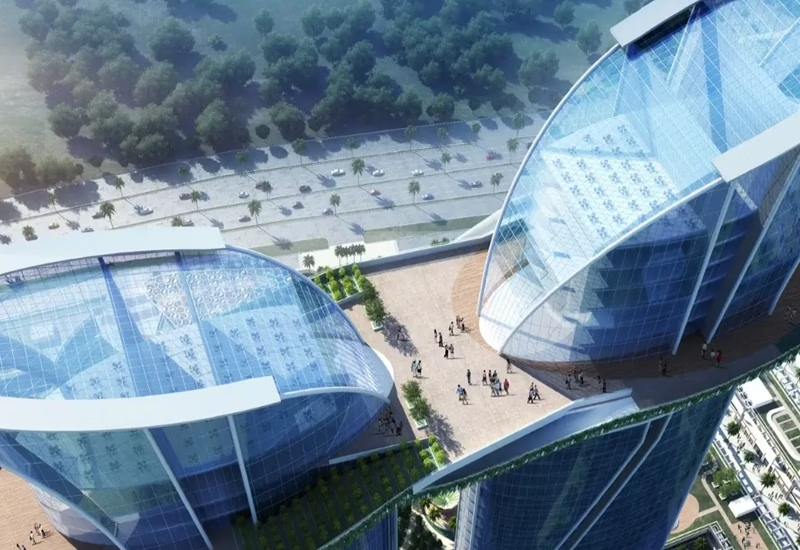
Noida-based realty player, Group 108, has received Part CC for its flagship project, Grandthum, in Greater Noida West. This milestone paves the way for over 1300 customers to begin receiving possession, reaffirming Group 108’s commitment to fulfilling its delivery promise and quality execution. Spread across 23 acres (approx.), Grandthum brings together signature office spaces, high-street retail, multiplex, dining, and leisure zones into a unified ecosystem. Since its launch in 2019, the development has emerged as a landmark in NCR’s commercial real estate landscape. Its twin signature office towers (G+34 and G+30 floors) come with Sky Deck on the 27th and 28th floors, offering panoramic views of the region. Adding to its appeal is a vibrant 8 lakh sq. ft.(approx.) high-street retail promenade with more than 100 outlets, a five-screen multiplex with 900 seating capacity, and zones dedicated to QSRs, High Energy bars, and experiential leisure. One of Grandthum’s most distinctive highlight is its Yacht Garden, an open-air zone with an approx two-acre water body, landscaped sit-outs, and lush green promenade designed to elevate the visitor experience. The project also offers multi-level car parking, three-tier security, high-speed escalators, and uninterrupted power backup, ensuring convenience and comfort at every touchpoint. Dr. Amish Bhutani, Managing Director, Group 108, said, “Receiving the Part CC for Grandthum and offering possession to more than 1,300 customers is a proud achievement for us. From the very outset, our vision was to create a development that is not only limited to real estate but becomes a complete ecosystem for work, retail, and leisure. This milestone reflects our unwavering commitment to quality, execution excellence, and our promise to deliver spaces that create long-term value for our customers.” Sanchit Bhutani, Managing Director, Group 108, added, “Securing Part CC further strengthens Grandthum’s position as one of NCR’s most prominent commercial developments, at a time when Noida–Greater Noida is witnessing strong interest from global businesses and MNCs. With world-class office infrastructure, a dynamic retail promenade, and lifestyle-driven offerings, Grandthum is well-placed to cater to the evolving needs of enterprises and communities alike. This is not just a regulatory milestone—it is the realization of our vision to establish a future-ready business and lifestyle hub for the region.” With over 60 marquee national and international brands on board, Grandthum is cementing its position as a premier destination for shopping, recreation, and community experiences. The project is also IGBC Platinum Pre-Certified, underscoring Group 108’s commitment to sustainability, energy efficiency, and responsible development. With its prime location near the upcoming Jewar International Airport, excellent connectivity to Noida, Delhi, and Ghaziabad, and proximity to a large catchment of over a few lakh families, Grandthum is set to emerge as one of NCR’s most vibrant and future-ready commercial destinations.
What’s next for India’s malls?

India’s shopping centres are no longer just destinations to buy—they’re destinations to belong. As spaces evolve, so must our imagination India’s shopping centres are evolving at a dramatic pace. No longer just spaces to transact, malls are now experience engines, cultural arenas, social hubs, and data-driven consumption ecosystems. And that’s the story the industry is coming together to explore and co-author at Shopping Centres Next (SCN) 2025, on July 23–24 in Goa. Organised by the IMAGES Group, SCN is India’s most influential forum for modern retail real estate stakeholders. This year’s theme, infused throughout the agenda, is a directional question: What’s next for India’s malls? The answers are emerging from a confluence of trends: rising Tier 2/3 aspirations, the institutionalisation of retail assets, AI-driven retail planning, and a radical redefinition of what it means to be a “mall” in the age of connected commerce. Let’s explore these shifts through a layered narrative inspired by the SCN 2025 agenda. Recode the Mall: Purpose, People, Possibility In this new era, malls must mean more. The old formula of footfalls and floorplates is giving way to climate-conscious architecture, hyperlocal tenant curation, and human-first design. Success Story: DLF Avenue Saket redesigned itself from a retail property into a curated social and cultural space, with art installations, pet-friendly zones, open-air courtyards, and a strong emphasis on F&B. Global Cue: Coal Drops Yard in London redefined mall culture by converting an old industrial warehouse into a high-design retail precinct, where shopping meets storytelling. Next: India’s future malls will need to prioritise ESG metrics, urban integration, and cultural programming to remain relevant. Shared Growth: From Landlords to Partners The landlord-tenant equation is being rewritten. Malls and retailers are increasingly entering co-risk, co-reward agreements driven by mutual performance and shopper-centricity. Case Study: LuLu Mall Lucknow partnered with 40+ tenants on a unified mall-wide festival, which increased weekend footfall by 27% and dwell time by 3x. Case Study: Pacific Malls created a major industry moment by launching the Pacific Festival of Shopping—a multi-city campaign across its properties in Delhi-NCR, Dehradun, and Jaipur. With over ₹2 crore in prize giveaways, curated weekend carnivals, and gamified app integrations for brand discovery, the campaign delivered 30% growth in weekend footfall and heightened brand visibility for over 100 participating retailers. Innovative Trend: Revenue-share leasing models, combined marketing campaigns, and shared customer data platforms. What’s Next: Co-created loyalty programs, unified digital wallets, and deeper brand-mall collaborations on experiential retail. III. Retail as an Asset Class: The Rise of REITs India’s shopping centres are becoming institutional-grade assets. REITs like Nexus Select Trust are proving that malls can be stable, income-generating platforms. Nexus Snapshot: 19 consumption centres 6 million sq ft retail GLA 130 million footfalls 2% occupancy INR 124 Bn tenant sales (FY24–25) Next: Expect consolidation of Grade A malls under REITs, more foreign institutional interest, and capital-backed innovation in mall operations. Beyond Brick & Mortar: Format to Ecosystem Today’s shopping centres aren’t just places to buy—they’re ecosystems that blend retail, dining, co-working, health, and culture. Case Study: Taurus Zentrum, Thiruvananthapuram is India’s first integrated retail destination located inside a tech park. The larger Taurus Downtown development offers over 700,000 sq ft of gross leasable area with retail, potential hospitality space, convention venues, and SEZ/non-SEZ parcels. This pioneering model brings lifestyle and commerce directly into Kerala’s IT corridor, with built-in customer flows from nearby tech campuses and government offices. Case Study: Avenue Mall @ Texvalley, Erode stands out as South India’s first and largest outlet mall, spanning over 500,000 sq ft within the 2 million sq ft Texvalley textile hub. Developed by Beyond Squarefeet, it fuses wholesale strength with aspirational retail, offering factory outlets, regional fashion brands, local artisans, F&B, and entertainment. Its curated Independence Day launch is set to mark a cultural milestone for Tamil Nadu’s Kongu belt and a new benchmark in Tier 3 retail transformation. Case Study: Phoenix Malls activated a mall-wide digital-first experience at Phoenix Mall of Asia in Bengaluru with QR-based rewards, influencer-led soft launches, and a cultural calendar featuring car rallies, stand-up comedy shows, and art installations. The launch phase saw over 20 million digital impressions and a 40% spike in weekday footfall compared to projections. Global Benchmark: Westfield Century City, LA offers valet parking, rooftop lounges, digital concierge, and event programming to enhance lifestyle relevance. Next: Mixed-use destinations will dominate; malls will function like mini-cities. Connected Commerce: From Browsers to Buyers Digital and physical are no longer distinct spheres. Today’s consumer expects to browse online, touch offline, pay anywhere, and receive products everywhere. Example: Inorbit’s e-Shop initiative lets consumers shop from their favourite mall brands online and pick up in store or opt for delivery. Global Trend: Malls offering smart parking, AR navigation, mobile POS, and in-mall app integrations. Next: Shopping centres as omnichannel fulfillment hubs; QR-led discovery in physical aisles; embedded online-to-offline triggers. Reviving the Empty: Activating Underperforming Zones Vacant zones hurt more than just revenue; they impact shopper perception. Leading malls are responding with creative reuse and short-format experimentation. Example: DLF Promenade’s Pop Box model cycles through emerging D2C brands every 30 days, bringing freshness to underused spaces. Next: Expect test zones, pop-up culture, influencer collaborations, and rotating themes to bring vibrancy back to quieter pockets. VII. Move the Market: Shared Consumer Strategy Malls and brands are no longer separate storytellers. Together, they must script narratives that connect emotionally and culturally. Example: Quest Mall Kolkata curates regional food festivals, Bengali indie cinema screenings, and local art to build deep cultural resonance. Trend: Brands creating mall-exclusive SKUs, storytelling-led visual merchandising, and mall-wide thematic events. Next: Mall as cultural platform—one that inspires, not just sells. VIII. The AI Advantage: Precision-Led Planning AI is transforming how shopping centres are built, leased, and managed. From catchment analysis to predictive leasing and tenant rotation, data is now the key tenant. Use Case: Inorbit Malls, in partnership with Waysahead Global, uses AI to predict catchment trends, plan tenant mix, and adjust lease durations. Next: Expect AI-driven mall layouts, heatmaps for dwell zone optimisation, and even tenant scoring models. Retail Architecture as Urban Catalyst Malls are increasingly shaping not just consumption but the very fabric of cities. Architecture, urban design, and
RERA reshapes India’s housing market, instills higher investor confidence: Knight Frank India
Knight Frank India, a leading real estate consultancy, together with NAREDCO, has launched its new report RERA’s Reign – Charting Real Estate Growth Post-2016, which examines the Act’s transformative role in India’s housing market. The report highlights how the Real Estate (Regulation and Development) Act, 2016 (RERA) has transformed India’s housing market by instilling transparency, discipline, and long-term confidence. It showcases that RERA has successfully moderated runaway housing prices while restoring consumer trust and attracting institutional capital to the sector. According to the report, with the implementation of RERA, speculative pricing in the housing market was brought under effective checks and balances. This policy intervention played a central role in aligning price growth with market fundamentals. Over time, with due processes in place and business restructuring on the supply side, the residential property market in India registered the much awaited growth post the last down cycle. Shishir Baijal, Chairman & Managing Director, Knight Frank India, said, “RERA has been one of the most impactful reforms for India’s housing market in recent times, making the sector more transparent and instilling accountability. Transparency and delivery discipline have given consumers the confidence to return to the market, while institutional investors are once again viewing residential real estate as a credible long-term investment story. This renewed balance in India’s housing market will go a long way in achieving sustainable growth.” The implementation of RERA has helped shift the housing sector away from speculative cycles, forcing developers to adopt compliance, transparency, and delivery-focused practices. For consumers, the result has been fairer pricing and renewed confidence in housing as a stable asset class. Investor Confidence Peaks Alongside improved affordability, investor confidence in Indian real estate has climbed steadily in the post-RERA era. The report highlights that cumulative private equity inflows surged to USD 26 bn between 2017–2020, compared to just USD 17.5 bn during 2011–2016. This influx of institutional capital reflects greater trust in the sector’s regulatory environment, signaling the success of RERA in building a more credible investment landscape. The performance of the NIFTY Realty Index further demonstrates this trend, showing stability and resilience in the post-RERA years. Large investors, once wary of opacity and delayed delivery, now view Indian real estate as a more predictable and disciplined market. According to the report, this structural shift has positioned India’s housing market as a long-term investment destination for both domestic and global players. RERA’s National Footprint Beyond prices and investments, RERA’s scale of implementation underlines its importance as the backbone of India’s housing market. By mid-2025, nearly 1.5 lakh projects and 1 lakh agents had been registered under the Act, while 1.5 lakh consumer complaints were successfully resolved This regulatory reach demonstrates not only the seriousness of RERA’s enforcement but also its growing acceptance among homebuyers and developers alike. For the first time, Indian homebuyers have had recourse to a structured grievance redressal mechanism, and developers have had to align their practices with strict compliance standards. The result has been a more transparent housing market, where accountability, timely delivery, and financial discipline are no longer exceptions but expectations. Saurabh Mehrotra, Executive Director–Valuation & Advisory, Knight Frank India, said, “For investors, this regulatory environment has helped create transparency and credibility in the residential sector, as reflected in the USD 26 bn private equity inflows since 2017. Since its inception, RERA has resolved 1.5 lakh consumer complaints while regulating projects and agents at scale. It has firmly established itself as the backbone of India’s residential real estate sector.” G Hari Babu, President, NAREDCO, said, “Over the past eight years, RERA has been nothing short of a game-changer for Indian real estate. As highlighted in the Knight Frank report at the 17th NAREDCO National Convention, housing sales in India touched an all-time high of ₹3.1 lakh crore in 2024, and nearly 1.5 lakh projects and 1.5 lakh consumer complaints have already been addressed under the RERA framework. This journey from opacity to transparency has rebuilt the trust of homebuyers, lenders, and global investors alike. The next step must be to evolve RERA into a more uniform, technology-driven framework across states so that the sector continues to be a backbone of India’s economic rise.” While RERA has laid a strong foundation, the report notes that more work remains to be done. Strengthening enforcement across states, harmonizing compliance frameworks, and adopting a “One Nation, One RERA” model will be critical to further enhance transparency and efficiency The report also recommends leveraging technology to streamline approvals and grievance redressal, alongside continued alignment with global best practices in real estate regulation. With India’s housing demand projected to rise steadily in the coming decade, sustaining confidence through consistent policy enforcement will be key. The data and insights presented in RERA’s Reign – Charting Real Estate Growth Post-2016 confirm that the Act has been a game changer for Indian housing. It has moderated prices, boosted investor confidence, and empowered consumers at an unprecedented scale. As RERA evolves into its next phase, it is poised to remain the cornerstone of India’s real estate growth story.
Bhumika Realty enters UP East, names Amit Tewari as Head of Sales for Lucknow & Ayodhya
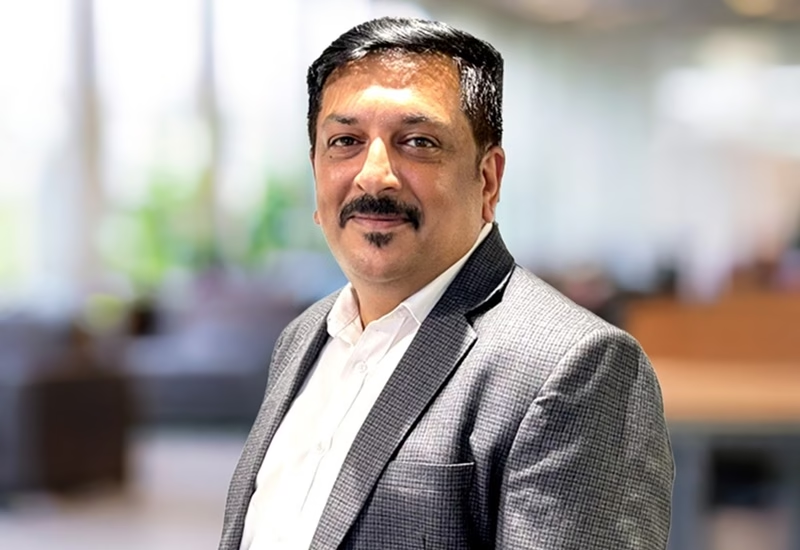
Bengaluru: After establishing a strong presence in Rajasthan and expanding into Delhi-NCR, Bhumika Realty has entered Eastern Uttar Pradesh, with real estate projects planned in Lucknow and Ayodhya. With integrated townships and mixed-use developments in the pipeline, the move marks a key step in the company’s goal to expand across North India in residential, commercial, retail, and hospitality segments. “Eastern Uttar Pradesh is witnessing a sharp rise in infrastructure investments and urban migration,” said Uddhav Poddar, Chairman and Managing Director, Bhumika Group. “We see this as a timely opportunity to bring our brand of responsible, design-led development to the region.” To support this growth, the company has appointed Amit Tewari as Head of Sales – Lucknow & Ayodhya. With nearly 20 years of experience at companies like DLF, Omaxe, Synergy Advisors, and Prominent Enterprises, Tewari brings deep expertise in real estate sales, revenue strategy, and market development. “As we deepen our presence in high-potential markets, the ability to scale with agility becomes essential,” said Siddharth Katyal, CEO, Bhumika Realty. “Tewari’s proven track record in building high-performance teams and navigating diverse market dynamics makes him a valuable addition to our leadership team.” “Bhumika Realty’s integrated and customer-centric approach is well-positioned to shape the next chapter of growth in UP East. I look forward to enabling meaningful expansion in the region by delivering quality-driven, future-ready real estate solutions,” added Tiwari. With successful commercial and retail developments such as Urban Square Mall in Rajasthan, Bhumika Realty is now laying the groundwork for a broader northern expansion, beginning with Lucknow and Ayodhya, and with additional UP cities under evaluation.
TCS signs 15-year, 1.4 million sq ft office lease deal in Bengaluru’s Electronic City
In one of the year’s largest office leasing transactions, Tata Consultancy Services (TCS) has signed a lease for 1.4 million sq ft at 360 Business Park in Bengaluru’s Electronic City. TCS has signed a 15-year lease for space across two under-construction office towers, committing a deposit of ₹112 crore and a monthly rent of ₹9.31 crore. With a 12% escalation every three years, the total rental outflow is expected to exceed ₹2,000 crore over the lease period, according to data from real estate analytics firm Propstack. According to a report in ET, the office space is spread across Towers 5A and 5B in the city’s southern IT corridor of Electronic City at 360 Business Park. The lease covers 6.8 lakh sq ft in Tower 5A and 7.2 lakh sq ft in Tower 5B, with a consolidated monthly rent of ₹9.31 crore at a rate of ₹66.5 per sq ft. The documents showed that TCS has also provided a security deposit of ₹112 crore. Another news report says that the lease will commence in two phases. Phase 1, comprising ground plus seven floors, is scheduled to start from April 1, 2026, while Phase 2, covering the 8th to 13th floors, will commence from August 1, 2026. Together, the two towers will add more than 1.4 million sq ft of Grade-A workspace for the IT services giant. This deal is one of the largest office leases in Bengaluru in recent years, reflecting strong renewed confidence among IT occupiers despite mixed demand and hybrid work trends. As per a report in Times of India, Amazon has leased over 1.1 million square feet from the Sattva Group in Bengaluru, while Google India has secured 1.6 million square feet at Bagmane Rio Park in the same city. Additionally, Google has renewed its lease for 370,000 square feet at Sattva Knowledge Capital in Hyderabad.
Vedanta Group wins Rs 17000 cr bid to buy Jaiprakash Associates, outbids Adani

Mining giant Vedanta Group has acquired Jaiprakash Associates (JAL) with a Rs 17000 crore bid, leaving behind fellow contender Adani Group. According to a PTI report, the mining conglomerate’s bid comes as JAL is undergoing insolvency proceedings after it defaulted on payment of loans. The bid value translates into JAL’s net present value of Rs 12,505 crore, the PTI report added. The other contenders including Jindal Power, Dalmia Bharat Group, and PNC Infratech did not submit their bids in the final bidding round. Vedanta Group, led by Anil Agarwal, won the bid in a challenge round under the Insolvency and Bankruptcy Code (IBC). A challenge process is a competitive bidding round run by the Committee of Creditors (CoC) to maximise recovery from an insolvent company. JAL – which has interests spanning real estate, cement, power, hotels, and roads – entered insolvency proceedings after defaulting on loan repayments. The National Company Law Tribunal (NCLT) Allahabad Bench admitted JAL to the corporate insolvency resolution process (CIRP) on June 3, 2024. According to reports, creditors have lodged claims of over Rs 57000 crore. Vedanta’s winning bid covers less than a third of what lenders are owed by JP Associates. CNBC had earlier reported that the National Asset Reconstruction Company Ltd (NARCL) leads the list of claimants after acquiring the stressed JAL loans from a consortium of lenders headed by the State Bank of India. JAL has major real estate projects like Jaypee Greens in Greater Noida, a part of Jaypee Greens Wishtown in Noida (both on the outskirts of the national capital), and the Jaypee International Sports City, strategically located near the upcoming Jewar International Airport. It also has three commercial/industrial office spaces in Delhi-NCR, while its hotel division has five properties in Delhi-NCR, Mussoorie, and Agra. The group has four cement plants in Madhya Pradesh and Uttar Pradesh, along with leased limestone mines in Madhya Pradesh, although the plants are currently non-operational. JAL also holds stakes in subsidiaries including Jaiprakash Power Ventures Ltd, Yamuna Expressway Tolling Ltd, Jaypee Infrastructure Development Ltd, and several others.
Japanese companies are turning to India for GCCs: Here’s Why!

Japanese companies are increasingly looking to India as a strategic hub for establishing Global Capability Centers (GCCs). Traditionally conservative in offshoring, these firms are now compelled by global competition, digital transformation, and talent shortages at home to explore new frontiers. India, with its proven track record as the world’s leading GCC destination, offers the right mix of scale, skill, and cost efficiency. The most critical driver is access to talent. Japan is grappling with an ageing workforce and limited availability of digital skills, while India produces a vast pool of engineers and IT professionals annually. This talent base is not just large but also highly skilled in emerging technologies like AI, data analytics, cloud computing, and cybersecurity—capabilities Japanese companies urgently need to accelerate digital transformation. India produces ~1.5 million STEM graduates every year; Japanese firms rate “access to India’s skilled talent pool” very highly (4.8/5 in a recent survey). Japan is facing a severe labour shortage and population aging: as of 2025, ~30% of Japan’s population is over 65; projections estimate workforce shrinkage of ~11 million by 2040. Cost competitiveness is another factor. Setting up a GCC in India allows Japanese firms to optimize operational expenses while gaining access to high-quality innovation. Moreover, India’s mature ecosystem of service providers, technology parks, and regulatory support makes it easier to establish and scale centers quickly. Companies report potential operational cost savings of up to 40% by shifting GCC functions or scale to India. Japanese labour and real estate costs are several times higher than equivalent costs in Indian cities, making India particularly attractive for functions that do not require local presence or local market exposure. Japanese corporates are also realizing that GCCs are no longer just back offices—they are innovation engines. Many are using India-based GCCs to drive R&D, product development, and global operations, positioning them closer to key growth markets in Asia and beyond. The presence of multinational GCCs in India further reassures Japanese firms that they can replicate proven models successfully. Japanese firms are lagging in certain digital technologies and facing rising pressure to modernize. GCCs are now being used not only for cost or support-functions but increasingly for R&D, AI/ML projects, automation, and advanced analytics. Example: Dai-ichi Life’s new GCC in Hyderabad (in partnership with Capgemini) will focus on AI, data analytics, cybersecurity to accelerate its global digital transformation. Finally, cultural adaptability and the growing India–Japan economic partnership make the move more attractive. With strong government-to-government ties, trade agreements, and joint initiatives in technology and infrastructure, India is emerging as a trusted partner. India’s GCC ecosystem is mature: good infrastructure, multiple preferred hubs (Bengaluru, Hyderabad, Chennai, Pune, Delhi-NCR), regulatory support, and policies favoring innovation and R&D. Bilateral trade and investment ties between India and Japan are strengthening; Japan is a major source of FDI in India. Japanese firms are no longer viewing India merely as a cost arbitrage location; instead, they are treating GCCs in India as strategic innovation hubs. The combination of an abundant tech talent pool, favorable cost differentials, governmental support, and pressing domestic constraints in Japan (aging, labour shortages, rising costs) create a strong case. As India continues to strengthen its infrastructure, policy framework, and ecosystem, more Japanese multinationals are expected to deepen investment, move upstream in value (towards R&D/engineering), and measure GCCs by performance and innovation metrics, not just cost savings.
Pinkwalk: Rajasthan’s Largest Retail & Lifestyle Destination
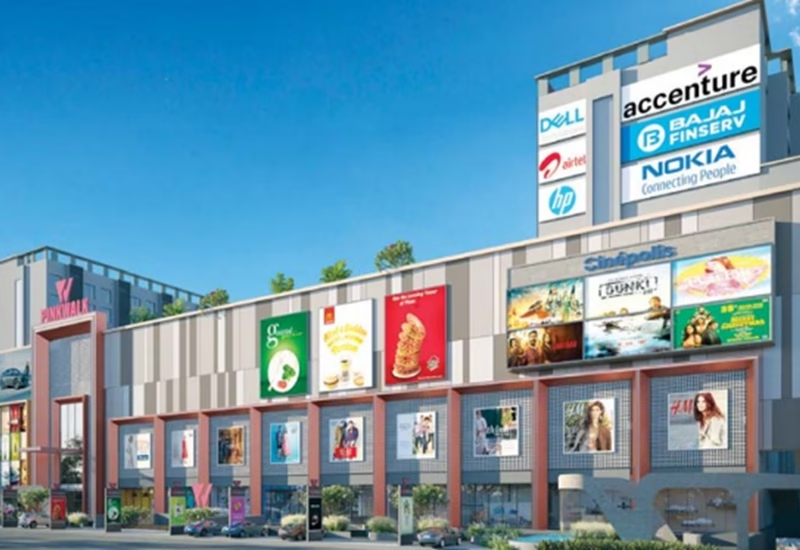
Manglam Pinkwalk is Rajasthan’s largest mall featuring a unique mix of retail stores, premium office spaces, and modern studio units, making it a prime destination for shoppers and professionals. One of its standout attractions is the tallest aquarium in the city, adding to its charm and exclusivity. Differentiating From Peers Strategically located at Jagatpura, Jaipur for easy access, Pinkwalk—which is slated for launch in October 2025—is not just a shopping hub, but also a promising investment opportunity. Rajasthan’s Largest Mall: Pinkwalk is designed to be the biggest retail and lifestyle destination in the state. Mixed-Use Development: Unlike conventional malls, Pinkwalk integrates premium offices, retail and studio spaces, offering workspaces within a commercial hub. Strategic Location & Investment Potential: Designed for higher footfall and business opportunities, Pinkwalk offers a more attractive investment option as compared to other malls in Jaipur. Luxury & High-Street Experience: The mall combines high-end shopping with a well-planned high-street zone for different retail categories, setting it apart from standard mall layouts. Pinkwalk is also differentiating itself in the kind of consumer experience it is looking to create with consumers. It aims to achieve this by: Grand Shopping Destination: Shoppers can explore a mix of luxury brands, high-street fashion, and exclusive designer stores. Immersive Entertainment & Leisure: With a multiplex, gaming zones, retail zones, cafés and the tallest aquarium, visitors can enjoy a dynamic and visually engaging experience beyond just shopping. Spacious & Aesthetic Ambience: Designed with modern architecture, open spaces, and high-end interiors, the mall provides a sophisticated, comfortable, and Instagram-worthy environment. Seamless Work & Freedom: Integrated premium office spaces and studios for professionals for a work environment that combines productivity with easy access to leisure and retail. Location Strategy Manglam Pinkwalk, located in Akshaypatra, Jagatpura in Jaipur, presents a significant market potential for retail and commercial ventures. The area boasts a dense residential population with relatively high per capita incomes, creating a robust customer base for businesses. Additionally, its proximity to key establishments and excellent connectivity across Jaipur enhance its appeal as a prime destination for retail and lifestyle enterprises. The location serves well since nearby marketplaces only consist of traditional and budget-friendly retail options. Pinkwalk, meanwhile, has positioned itself as a premium lifestyle destination with high-end brands, gourmet dining, and exclusive experiences. To cater the current market, retail has been segmented into 6 different zones which consist of kiosks, small shops and large showrooms. To assist local markets in getting organised and thrive in their businesses, Pinkwalk will also boast the largest flea-market zone in Jaipur and specifically in the Jagatpura area. “We are expecting majority of footfall from nearby areas like Jagatpura, Malviya Nagar and Mansarovar. It expects a weekly footfall of approximately 70,000 – 90,000 people, which is likely to increase during events and in festival season,” said Ajay Gupta, Director, Manglam Group. Balancing Aesthetic Appeal with Functionality, Convenience To attract diverse demographics Pinkwalk will implement tailored strategies that appeal to various groups, ensuring a mix of retail, entertainment, offices, studios, café and experiences that cater to their needs. Towards this, the mall has worked towards the following: Building the Tallest Aquarium in Rajasthan: making Pinkwalk a family-friendly, Instagrammable Rooftop Dining & Experience Zone: The rooftop dining area provides a premium ambiance with a city view, enhancing the dining experience. Multi-Level Shopping & Entertainment Zone: Offers a well-structured layout for shopping, offices, dining, and entertainment, catering to diverse customer needs. Walkable Shopping Street Concept: Provides an open-air retail experience with dedicated pedestrian walkways, enhancing shopper engagement. Grand Façade with Modern Aesthetics: The glass-and-art façade makes the mall visually striking, attracting high-end retailers and brands. Curating the Right Tenant Mix A successful mall curates its tenant mix by balancing anchor brands, high-footfall categories, and niche offerings that reflect local consumer preferences. This involves analysing demographics, shopping behavior, and market gaps to ensure a diverse yet complementary mix that drives traffic, dwell time, and repeat visits. This is exactly what Pinkwalk has done. Visitors can access and enjoy the following types of brands and stores: National and international apparel and accessory brands Dedicated gaming zone for entertainment Food joints including food chains and local brands on rooftop and food zone 6-screen multiplex operated by cinepolis Specified flea market zone (kiosks) for local manufacturers including mix variety of products Embracing Technology Integrating technology helps malls enhance customer experience through smart navigation, personalised offers, and real-time engagement. It also enables data-driven decision-making for operations, tenant performance, and marketing, making the mall more efficient and future-ready. Pinkwalk is embracing the tech-age by: Smart parking systems using Fastag for entry and exit with easy car tracking Directional touchscreen kiosks and mobile based navigation system 3D screens for promotional activities Sensors for real time hygiene levels & automated cleaning schedules App based & offline loyalty reward points using AI for customer engagement AI-powered CCTV monitoring, facial recognition for access control, and emergency response systems. “The mall will also leverage data analytics to understand consumer behaviour and enhance shopping experience. This will help them improve customer experience through personalised engagement with visitors, optimise retail space utilisation and pricing, enhance marketing effectiveness with targeted promotions, organise mall events and promotional campaigns for customers, drive loyalty programs based and data and identify popular product categories and spending patterns by captured POS data,” explained Gupta. Aside from this, the mall is also embracing sustainability by using automated temperature regulation to prevent energy wastage; supporting electric vehicle adoption with dedicated EV charging stations; encouraging responsible waste disposal with clearly labeled, segregated waste bins for recycling; planting terrace plantations and green zones within the mall to enhance air quality; using energy-efficient lighting systems to reduce electricity consumption and having automated controls for lighting, temperature, and ventilation to optimise energy use; maximising the use of natural light and daylight through skylights and glass ; and finally by collecting and reusing rainwater for landscaping and non-potable purposes. The mall aims to achieve a Platinum Green Certification. Pinkwalk plans to build dedicated business and co-working spaces within the