
eBay launches GCC at Embassy Tech Village, Bengaluru; delivered by Awfis

Global commerce giant eBay, which enabled $75 billion in gross merchandise volume in 2024, has inaugurated its new Global Capability Centre (GCC) in Bengaluru. Located at Embassy Tech Village on the Outer Ring Road, the 65,000 sq ft facility will serve as a technology and innovation hub, housing functions across AI/ML, engineering, applied research, product development, data analytics and more. The centre is expected to host over 300 engineers and will play a critical role in scaling AI-driven customer experiences and accelerating product innovation across eBay’s 190 global markets. Highlighting India’s vibrant e-commerce ecosystem and unmatched technology talent, Mazen Rawashdeh, SVP & Chief Technology Officer of eBay, said Bengaluru was a natural choice for expansion. “By investing in India, we are strengthening our ability to serve 134 million active buyers worldwide while positioning ourselves for long-term growth in emerging regions,” he noted. With 2.4 billion product listings and 10 million unique sellers already leveraging generative AI features, eBay said its Bengaluru teams will have global visibility and impact as the company advances its AI-first commerce strategy. eBay’s foray into Bengaluru was facilitated by Awfis Space Solutions Limited, one of India’s India’s largest flexible workspace provider and the country’s first publicly listed workspace solutions platform. Awfis’ mandate included designing, building and managing the new office for eBay, which will serve as a strategic hub, supporting a diverse set of functions and accelerating eBay’s AI-first commerce strategy. The centre – while driving advancements in AI, research and innovation – will play a pivotal role in eBay’s continued growth in India. Its location at Embassy Tech Village – the city’s largest operational office park – offers robust connectivity between the international airport and the city centre, and access to vibrant commercial and social infrastructure. Commenting on the development, Amit Ramani, Chairman & Managing Director of Awfis Space Solutions Limited, said: “This mandate is a strong validation of Awfis’ ability to deliver future-ready, high-quality workspace solutions that align with the strategic needs of GCCs and large enterprises. Our collaboration with eBay underscores our position as the partner of choice for leading international clients, including those in the GCC region, who seek scalable, innovation-driven work environments. We are proud to play a role in enabling eBay’s global innovation journey through this new centre in Bengaluru.” As of June 2025, Awfis has 39 operational centres in Bengaluru, strategically located, offering state-of-the-art amenities and experiences curated to make the workplace experience efficient and productive. The Group has also recently helped launch 2 Elite centres at Manyata Tech Park and Prestige Venus, offering ~ 80,000 sq ft. super built-up in the city. The mandate was facilitated by Zinnov, a leading global consulting firm known for helping enterprises build, scale, and transform their global capability centres (GCCs). With this milestone, Awfis reinforces its position as India’s leading end-to-end workspace solutions provider, going far beyond offering just space. As of 30th June 2025, with 230+ centres, more than 1.5 lakh seats across 18 cities, and a diverse portfolio of workspace formats, mobility solutions, and allied services, Awfis delivers a unified, customer-centric ecosystem designed to meet every business need. By creating vibrant, tech-enabled environments that foster productivity, collaboration, and innovation, Awfis continues to set new industry benchmarks and redefine the future of work.
As Blackstone Acquires South City Mall, Nexus Select Trust May See Portfolio Expansion to 20 Malls Across 16 Cities, 11.65 Mn Sq. Ft. GLA
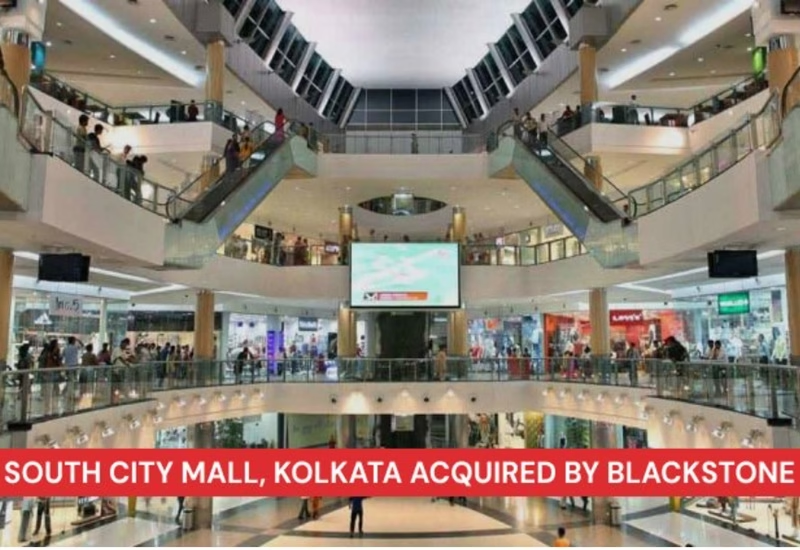
In one of the largest retail real estate deals of the year, Blackstone Group has acquired South City Mall, Kolkata’s premier shopping destination, for approximately ₹3,250 crore. The deal marks Blackstone’s first significant retail investment in Eastern India, expanding its already substantial footprint in the country’s organised retail sector. While there’s no official confirmation yet of its inclusion in the Nexus Select Trust portfolio, previous Blackstone acquisitions in India — including Select Citywalk, Elante, and the Prestige malls — were eventually consolidated under Nexus. Should the mall be added, Nexus Select Trust’s portfolio would expand to 20 malls across 16 cities, with a total Gross Leasable Area (GLA) of 11.65 million sq. ft. South City Mall: A Retail Landmark Launched in 2008 by a consortium of Kolkata-based developers, South City Mall spans 1 million sq. ft. on Prince Anwar Shah Road. Anchored by a mix of premium Indian and international brands, a 1,400-seat food court, and a loyal catchment, the mall reportedly clocks annual turnover of ₹1,800 crore with weekend footfalls exceeding 2 lakh. The asset is expected to benefit from Blackstone’s global retail expertise and operating leverage. Market sources indicate the acquisition was structured through a mix of equity and financing, valuing the mall at a benchmark-setting ₹32,500 per sq. ft. Strategic Implications for Blackstone Eastern Gateway: This marks Blackstone’s first major retail asset in East India. Earlier, in 2018, it had acquired a majority stake in Esplanade One, Bhubaneswar (developed by Forum Group). Top-Tier Asset: South City is among India’s most profitable malls in terms of revenue per sq. ft. REIT Enhancement: The asset is expected to strengthen Nexus Select Trust’s earnings and investor appeal, if included. Long-Term India Bet: This deal aligns with Blackstone’s continued confidence in India’s consumption-led growth trajectory. Nexus Select Trust: Now 20 Malls Strong If South City Mall joins the fold, Nexus Select Trust would have: 20 malls Presence in 16 cities 65 million sq. ft. of GLA Already the largest retail platform in India, Nexus manages a portfolio spanning metros and Tier 2 cities. In FY24–25, it reported 130+ million footfalls, ₹12,400 crore in tenant sales, and 97% occupancy. A REIT With Momentum Under the leadership of Dalip Sehgal, Nexus Select Trust has been reshaping post-pandemic retail in India by focusing on: Experiential formats(entertainment, F&B, co-working) Optimised tenant mix Digitally driven engagement Strong ESG practices With Blackstone’s continued support, Nexus is actively pursuing Tier 1 and high-density Tier 2 city assets, backed by sustainable NOI and consumer loyalty. Outlook: India as a Global Retail Play India’s organised retail footprint is projected to exceed 160 million sq. ft. by 2027, fuelled by urbanisation, rising incomes, and aspirational spending. With the acquisition of South City Mall, Blackstone signals its confidence in East India’s retail potential, while Nexus Select Trust stands poised to further consolidate its position as India’s most balanced and diversified retail platform.
Mumbai strengthens its position as India’s data centre capital: Knight Frank

Mumbai records 97.6MW of take up in H1 2025 Vacancy rate tight at 5.4% despite robust new data centre supply Knight Frank, in its latest report, Asia-Pacific Data Centres 2025, highlights Mumbai’s rise as India’s data centre capital. According to the report, the city leads India’s data-centre landscape accounting for 40% of total national capacity and 44% of live IT capacity. In H1 2025, Mumbai’s capacity rose 14.3% to surpass the 4GW milestone, with 591MW operational, 185MW under construction, and 3.2GW in the pipeline. This growth builds on India’s data centre market surpassing 10GW in H2 2024, supported by 1.4GW live and 400MW under construction. Rapid cloud adoption, increasing data localisation requirements, as well as the growth of local fintech and BFSI firms has been fuelling data-centre demand. Over the past six months, Mumbai recorded 97.6MW of take-up. This has translated to a tight vacancy rate of just 5.4% vs. India’s overall colocation vacancy rate at 12.3%. Demand-side commitments seem resilient with absorption broadly keeping pace with the multi-fold growth in supply over the past years. Also, two-thirds of Mumbai’s capacity under construction at present is already pre-leased. Yet, with just three live sites currently capable of supporting hyperscale deployments (>2.5MW) and only one site with available capacity of more than 10MW, there seems to be a short-term supply tightness for big-ticket requirements. Distribution of available live capacity is skewed toward smaller deployments: 10 sites offer <1MW, 5 sites fall in the 1–2MW range, while only 3 sites provide >3MW. Such fragmented deployments are opening doors for well-capitalized global players and joint ventures to deliver high-capacity facilities in the region that is currently dominated by local players. The 500MW NAV2 campus announced by NTT and another 500MW AI facility by Blackstone-Panchshil Realty are case in point. Also, operators with large-scale requirements are exploring alternative markets. Hyderabad is positioning itself as a hyperscale-first market, with over 500MW of new data centre capacity currently in the pipeline through two projects. STT GDC India has signed an MoU with the Telangana government to develop a 100MW campus, while NTT has committed INR 10,500 crore (approximately USD 1.25 bn) to establish a 400MW AI-focused data centre campus. Hyderabad is the second largest data centre market in India with 2.1GW of total capacity, followed by Chennai (1.6GW), New Delhi (712MW) and Bengaluru (307MW). Shishir Baijal, Chairman & Managing Director, Knight Frank India, said: “Mumbai has firmly established itself as the epicentre of India’s digital infrastructure growth. With over 3GW of capacity in the pipeline and strong policy support for green data centre parks, the city is attracting sustained global investment. As cloud adoption and AI workloads accelerate, Mumbai’s unique strengths, its robust subsea cable connectivity, scalable power infrastructure, proximity to enterprise hubs, and progressive state policies are consolidating its position as India’s data centre capital. While other metros like Chennai, Hyderabad, and Bengaluru are gaining traction, none match Mumbai’s scale, speed, and ability to serve as South Asia’s gateway for cloud, AI, and enterprise workloads.” Regional Context In the first half of 2025, the APAC region secured nearly 13GW of new project announcements, a 160% increase and more than double the 5GW announced in the same period last year. The funding needed for these projects already exceeds US$180 billion. Major technology firms are driving much of this investment. Amazon is projected to exceed US$100 billion in capital expenditure for 2025, up from about US$82 billion last year, while Microsoft invested US$55 billion in 2024 and has committed more than US$33 billion this year. Collectively, Microsoft, AWS, Google, and Meta have committed over US$160 billion in 2025 alone, reflecting the intensity and scale of current infrastructure development. Fred Fitzalan, Head of Data Centres Asia-Pacific, Knight Frank says, “The sheer volume of new projects in the region highlights just how important the region has become in the global digital infrastructure landscape. However, coordinating this rapid growth is a complex challenge, as operators must keep pace with advances in technology and rising energy needs, all while ensuring new facilities are delivered in step with evolving demands.” Alongside the hyperscalers, GPU-as-a-Service providers are expanding rapidly, seeking multi-megawatt capacity across the region and bringing greater diversity into leasing conversations. Creditworthiness and shortened deployment timelines remain perennial challenges, but innovative guarantee structures are enabling some operators to compete effectively for new contracts. Fred Fitzalan adds, “What has become clear is the strict requirement for operators to design facilities with capacity that can be flexibly deployed for either Cloud or AI workloads, offering tenants maximum optionality. While this adds cost, it is now a decisive factor in site selection. Locations that combine proximity to parent sites with sufficient power allocations to support long-term runway are winning out, although this remains a significant challenge given national grid constraints and permitting delays in Tier 1 APAC markets.” Johor (located in Malaysia) established itself as Southeast Asia’s fastest-growing data centre hub, with aggregate supply nearly doubling over the last 12 months to 5.8GW in Q2 2025, including 2.0GW of new project announcements, backed by strong government support and the rollout of national Data Centre Planning Guidelines. Take-up: Johor recorded 260.0MW of take-up in the first half of 2025, with social media accounting for 61% and the remainder driven by AI demand. The market is now highly constrained, with a vacancy rate of just 1.1%, as planning becomes more challenging and power shortages coming through. Tokyo continues to hold its position as a key regional hub with aggregate capacity exceeding 4.2GW, a 2.7% increase on volumes recorded at the end of Q2 2024. Investment activity remains strong, highlighted by Ares completing a US$2.4 billion Japan-focused fund through Ada Infrastructure, while Mitsui & Co. Asset Management’s US$122 million acquisition signals sustained domestic investment appetite. Take up: Over the past six months, Tokyo recorded 41.1MW of capacity transacted. This is a slowdown from the first half of 2024, when 286.6MW was transacted, due to reduced supply in the market. Tokyo continues to be a tightly constrained market, with colocation
Bengaluru, Mumbai, Delhi among top 15 global prime residential markets: Knight Frank
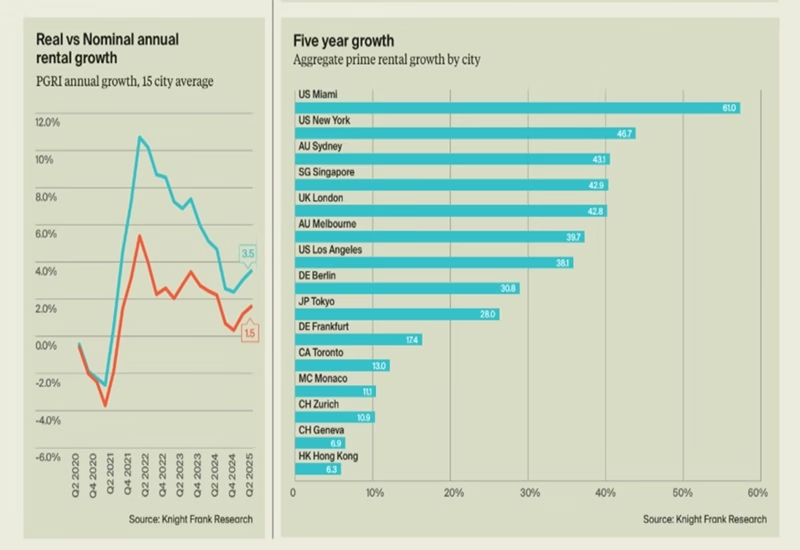
Knight Frank’s latest Prime Global Cities Index (PGCI) Q2 2025 reveals that Indian prime residential markets continue to outperform many global peers, with Bengaluru (10.2%), Mumbai (8.7%), and Delhi (3.9%) ranking within the top 15 among 46 global cities tracked. Despite a global cooling in prime residential price growth—averaging 2.3% annually compared to 3.5% in Q1 2025—Indian cities remain resilient, reflecting strong demand, limited prime supply, and sustained wealth creation in urban centres. Globally, Seoul led the rankings with 25.2% annual growth, followed by Tokyo (16.3%) and Dubai (15.8%). Bengaluru secured the 4th position worldwide, with Mumbai and Delhi at 6th and 15th respectively. Shishir Baijal, Chairman & Managing Director, Knight Frank India, said, “India’s prime residential markets have shown remarkable resilience, standing out in a year when global growth momentum has eased. Bengaluru’s tech-driven wealth creation, Mumbai’s renewed infrastructure-led appeal, and Delhi’s steady luxury demand have collectively kept India in the global spotlight. We anticipate that continued economic stability, urban redevelopment, and the appeal of prime assets as long-term wealth stores will support price growth in the months ahead.” Liam Bailey, Knight Frank’s Global Head of Research, commented, “Prime markets are taking a collective breath. The recovery we have seen over recent quarters was aided by the expectation of lower borrowing costs, and with that timeline now pushed out, a cooling in price growth is inevitable. We’re seeing a more fragmented market, with some European cities showing surprising strength while former high-flyers in Asia begin to level off.” The Prime Global Cities Index is a valuation-based index tracking the movement of prime residential prices across 46 cities worldwide using data from Knight Frank’s global research network.
Smartworks achieves milestone with largest Mumbai campus, over 557,000 sq. ft. at Intellion Park
Smartworks Coworking Spaces Limited, one of India’s largest managed office platform by total area under management, has reinforced its leadership with over 557,000 sq. ft. campus at Intellion Park, Navi Mumbai, a marquee development by Tata Realty and Infrastructure Limited. Intellion Park is Smartworks’ largest managed office campus in Mumbai. With this addition, the company’s leased portfolio in Mumbai has crossed the 1 million sq. ft. milestone, a landmark achievement in India’s financial capital. Strategically located on the Thane Belapur Road, Intellion Park is poised to be the largest IT Park in Navi Mumbai. The micro-market is backed by a well-established social and physical infrastructure, offering excellent connectivity, thriving residential hubs, and access to a strong talent pool. The new campus is already attracting interest from marquee clients, drawn by its prime location and comprehensive amenities designed for workforce productivity. Commenting on the campus, Neetish Sarda- Managing Director & Founder, Smartworks, said: “Mumbai is a strategic market and enterprise demand here continues to accelerate across sectors. Intellion Park, our largest managed office campus in the city, is designed for enterprises that need scale, speed, and experience under one roof. Crossing over 1 million sq. ft. leased portfolio mark in Mumbai is not just a milestone, it reflects the deep trust enterprises place in our model and our ability to deliver at scale.” With pre-certifications including LEED Platinum, IFC Edge, and WELL Gold, the campus integrates solar power, smart automation, underdeck insulation, and high-efficiency LED lighting — delivering measurable reductions in energy use while supporting enterprise ESG goals. Sanjay Dutt, Managing Director & CEO, Tata Realty, said: “Our partnership with Smartworks, a proven leader in managed campuses, reflects a shared vision to create world-class, future-ready work environments. With Intellion Park set to become Navi Mumbai’s largest IT Park, and Smartworks’ expertise in building scalable, enterprise-grade campuses, this collaboration is poised to set new benchmarks in the region’s commercial real estate landscape.” As the category creator of the Managed Campus model, Smartworks combines scale with reliability. With Intellion Park added in Q1 FY26, the company has deepened its presence in Mumbai and reinforced its unmatched scale and leadership in the managed office category nationwide. Smartworks already has four large campuses in its portfolio, each exceeding 500,000 sq. ft., including its flagship ~700,000 sq. ft. campus at Vaishnavi Tech Park in Bengaluru. The company leases large bare-shell properties and transforms them into Smartworks-branded, fully serviced campuses with aspirational amenities such as cafeterias, gyms, sports zones, crèches, medical centres, and convenience stores. Its large campuses allow enterprises to expand seamlessly with custom layout, design, and tech-enabled offices delivered in just 45–60 days. Smartworks has a footprint of ~12 million sq. ft. across 14 cities in India and Singapore, serving 730+ marquee clients including Google, Persistent, Groww, EY, Xoriant, and Discovery. About Smartworks Coworking Spaces Limited Smartworks Coworking Spaces Ltd (‘Smartworks’) is the largest managed office platform by total area under management ~12 million sq. ft across 14 cities in India and Singapore. The company serves as a one-stop workspace solution for companies. The company leases entire/large bare shell properties in prime locations from landlords and transforms them into fully serviced, ‘Smartworks’ branded, and tech-enabled Campuses with daily-life and aspirational amenities —cafeterias, sports zones, convenience stores, gyms, crèches, and medical centres. Smartworks focusses on mid-to-large Enterprises and has a diverse client base of over 730, which includes Forbes 2000 companies, MNCs, Indian conglomerates and startups.
SPJ True Realtyy unveils Gurugram-based commercial destination, Vedatam
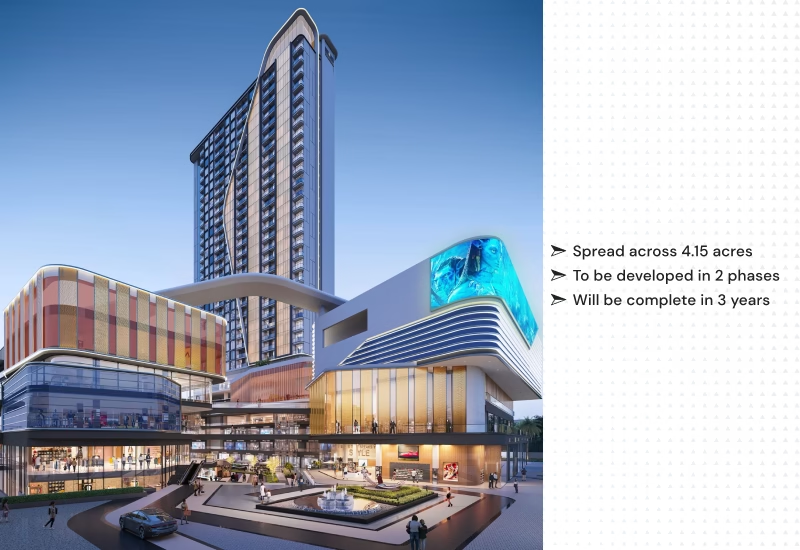
SPJ True Realtyy, the real estate arm of the SPJ Group, unveils Vedatam, a high-street retail development in Sector 14, Gurugram. With an investment of approximately Rs. 500 Cr, the project is designed to redefine retail, leisure, and urban living, becoming the first organised commercial hub in this part of the city. The project’s total estimated sales realisation is expected to exceed ₹1,000 crore, funded through promoter equity and sales proceeds. Spread across 4.15 acres, Vedatam will be developed in two phases over a three-year timeline. The development will feature over 400 premium commercial units and approximately 140 thoughtfully designed residences in (Phase- II), combining retail vibrancy with community living. Currently, the company has launched two floors in its retail segment offering spaces priced between ₹25,000 to ₹45,000 per sq. ft. on built-up area. Centrally located to serve 11 adjoining sectors, including 8, 12, 14, 15, 16, 17, 22, 23 and Palam Vihar, Vedatam is designed around a curated retail, F&B, and entertainment mix. The retail segment spans three levels, Lower Ground, Upper Ground, and First Floor, ensuring high visibility for brands and seamless shopping experiences. The second floor is a culinary destination with fine dining, multi-cuisine outlets, a brewery, and a spacious food court, while the third-floor houses Sector 14’s only multiplex operated by PVR, alongside more F&B options. Pankaj Jain, Founder and CMD, SPJ Group, said, “We believe that locations like Sector 14, densely populated yet untapped in organised retail, hold immense potential, and Vedatam is our answer to that opportunity. With this project, we are setting a new benchmark in neighbourhood retail and mixed-use development in Gurugram. Vedatam reflects our commitment to creating vibrant, sustainable ecosystems that blend lifestyle, leisure, and community living.” With over 1,100 car parking spaces (including a unique three-level parking system), high-speed elevators and escalators, 100% power backup, advanced fire safety, and earthquake-resistant construction, Vedatam is engineered for operational ease and visitor comfort. Future phases will introduce premium residences and an exclusive clubhouse, fully realising the live-work-play vision. Vedatam enjoys seamless access to NH-48, Old Delhi-Gurgaon Road, and the Dwarka Expressway, ensuring smooth mobility across NCR. It lies just 3 km from HUDA City Centre Metro Station and 5 km from MG Road Metro Station, while business districts like Cyber City, Udyog Vihar, and Golf Course Extension Road are all nearby. The IGI Airport is just a 20-minute drive away, making Vedatam a truly connected destination for modern urban living. With a focus on innovation, quality construction, and strategic land positioning, SPJ True Realtyy aims to redefine the real estate narrative in NCR. Backed by the legacy and financial strength of the SPJ Group, Vedatam aligns with the company’s commitment to delivering projects that not only meet but exceed modern urban aspirations.
6 parks planned to position Maharashtra as Technical Textile leader: Minister Sanjay Savkare
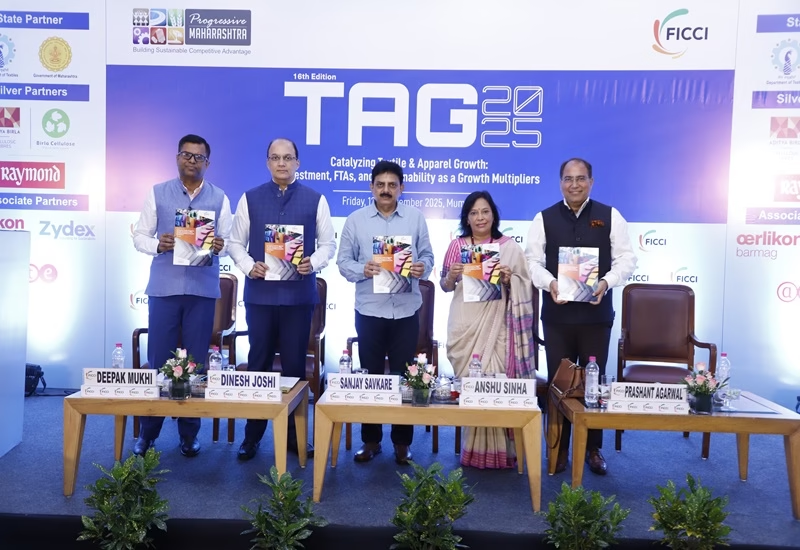
Sanjay Savkare, Minister of Textiles, Government of Maharashtra said that the Maharashtra Government, through its policy measures, is focusing on attracting domestic and foreign investment and providing support on skilling, R&D and infrastructure development to build globally competitive textile & apparel industry in the state. He stated that authorities are working towards establishing 6 technical textile parks, one in each of the revenue divisions, to make Maharashtra a hub for Technical Textiles. Speaking at a FICCI event, Sanjay Savkare added that state has set up a task force to seek suggestions from stakeholders to enhance the export competitiveness of Maharashtra as well as gain suggestions on the support that the Textile Industry can expect. The event saw the release of the FICCI–Wazir Advisors Textile industry report, ‘Catalysing Textile & Apparel Growth: Leveraging Global Opportunities’. Anshu Sinha, Principal Secretary (Textile), Government of Maharashtra also spoke on the need for collaboration and collective efforts of industry, academia and government to further strengthen Maharashtra’s position as a leading textile manufacturing hub, while seeking support of the industry in the areas of skilling, R&D and sustainable practices. Prashant Agarwal, Joint MD, Wazir Advisors shared a brief overview of FICCI – Wazir Advisors Report, which takes stock of the global and Indian textile & apparel (T&A) landscape in a year marked by geopolitical uncertainty, shifting trade flows, rapid advances in sustainability and innovation, and the challenges arising from the US reciprocal tariff scenario. The report also talks about what strategies India can adopt to fully realize its potential and position itself as a leading global hub. The report states that Global textile & apparel trade reached ~US$ 893 billion in 2024, reflecting 5% growth over the previous year, with China retaining one-third share. The global apparel market, now at US$ 1.8 trillion, is projected to touch US$ 2.3 trillion by 2030. India, with a US$ 184 billion domestic T&A market and US$ 37 billion in exports (FY25), continues to hold strong fundamentals but faces challenges from newly imposed US tariffs of 50%, compared to lower rates for competitors like Bangladesh and Vietnam. The report identifies garmenting investments as the central lever for India’s next phase of growth, supported by FDI inflows, global alliances, and government schemes like PLI and PM MITRA Parks. It highlights how forward integration into apparel manufacturing can enhance value addition, create large-scale employment, and improve India’s competitiveness as an end-to-end sourcing hub. It also emphasises innovation and sustainability as twin imperatives—ranging from smart textiles, eco-friendly materials, and digitalized supply chains to scalable adoption of green manufacturing practices. It further underlines India’s factor cost advantages over peers, while cautioning that weak R&D and lack of FTAs with key markets remain bottlenecks. The way forward, according to the whitepaper, rests on market diversification beyond the US, policy stability, infrastructure development, R&D and skilling, and embedding sustainability across the value chain. By combining investment-led growth with innovation and global partnerships, India can not only withstand tariff headwinds but also position itself as a leading global sourcing destination by 2030.
HiLITE Group: Creating Experiential Centres for the Community
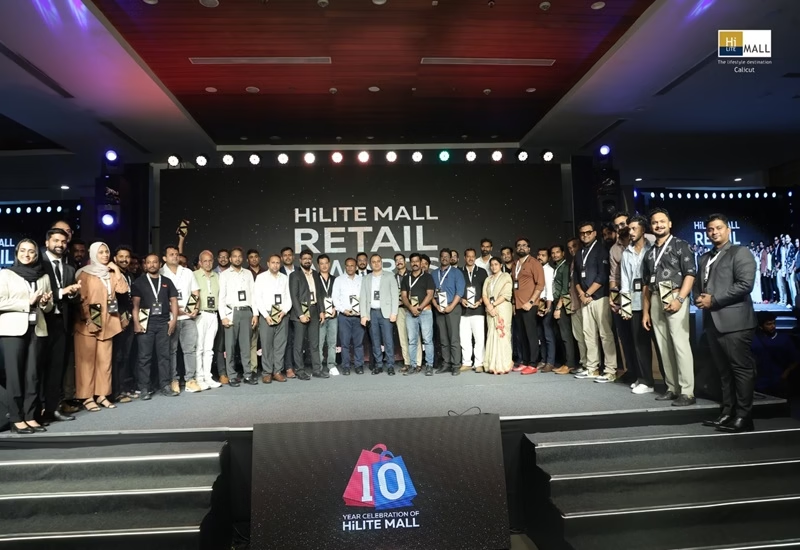
Since their inception, HILITE Group of malls have been rated high on brand mix, architectural brilliance and footfall, and have been credited with bringing in a retail revolution in God’s own country, Kerala. Their flagship mall, HiLITE Mall Calicut has been awarded CWAB Award for the ‘Most noteworthy project’ in the Retail category in India. With a built-up area of 12.6 lakhs sq. ft., and a leasable area of 8.1 lakh. sq. ft., it houses more than 200 local, national and international brands. The mall is part of the integrated township project, HILITE City, comprising commercial, retail and residential spaces. Located amid lush greenery at Thondayad bypass, Calicut, the City is rated to be one of the largest mixed use development projects in the country. Anchor stores like Nesto Hyper, Lifestyle, Shopper Stop, Max, Reliance Trends, R&B, Pantaloons, Stories and Home Centre provide a diverse range of value-driven products. HiLITE Mall has recently added some of World’s leading designer lifestyle brands like Superdry, GAS, Rare Rabbit, Nautica, Jack & Jones etc. in addition to its existing line of brands like Tommy Hilfiger, Calvin Klein, Levis, US Polo, UCB, etc., setting the tone of elegance and sophistication. The 8 Screen Multiplex – Palaxi Cinemas opened with a whole new world of shopping and entertainment. The massive multi-cuisine food court in the mall offers incredible dining experience with options for specialty dining and quick bites. For all the coffee lovers, Starbucks has also opened its first outlet in Northern Kerala. The family entertainer has also come up with an array of options for gamers with Amoeba, Timezone, Bounce, Snow Fantasy, T6 Paintball & Go-Karting marking a real new age in leisure and entertainment. In short, HiLITE malls are vibrant, young and happening places, which offer the best of experience in fashion, food, and entertainment for discerning shoppers. Zeroing In On The Small Town The HiLITE Group now has four malls including their flagship mall in Calicut. The other three are The Focus Mall in Kerala, a newly opened 8 lakh sq.ft. mall in Thrissur and a third mall which the group has taken over in Perindalmana. “We are all set to launch Palaxi Cinema in our Thrissur mall as well as a massive gaming zone. The mall already has a LuLu hypermarket and a fully operational food court. The sales here are more than we had expected, even though a few stores are yet to open. I am sure that in another two months, it will be an even bigger attraction than what it is now,” says Muhamed Fawaz, CEO, HiLITE Urban. Fawaz explains that Kerala is a very different market, with a lot of potential. “This potential is not visible only in major cities, but also in Tier 2 towns and beyond. It is these smaller towns that we are focused on. We see a bright future here because people have a lot of purchasing capacity but don’t have the right places to go to for shopping and entertainment,” he explains. Evolution of Physical Retail in a Digital World Malls remain relevant in a digital world because they offer experiences e-commerce can’t replicate—tactile product trials, social interaction, entertainment, and instant gratification. As consumer behaviours evolve, malls are transforming into lifestyle hubs that blend shopping with dining, leisure, and community engagement, making them more than just places to buy—they’re places to belong. “Awareness comes online but purchases are still happening predominantly in offline stores. The physical retail experience still matters a lot, for sure, especially in smaller towns,” says Fawaz. He explains that HiLITE focuses on making their malls into community centres, places where people can shop, eat, and turn to for entertainment options—all under one roof. The group also thinks differently to cater to its target audience. For example, the Calicut mall has a food court as its first level, since it is located on a very busy highway leading to Ooty. The hypermarket, in contrast, is on a higher level. The idea is to make the mall a comfortable pit stop for weary travelers. Experience is Key Fawaz stresses on the fact that while brands and products are important, experience is key in running a mall. “When people think about spending a day outside the house, they should think of HiLITE malls. That’s the idea. In keeping with this, we have added a lot of activities (to the Calicut mall) aside from an FEC. There is a Snow Park, games like billiards, events. All these activities help us stay relevant in the minds of consumers. Recently, the HiLITE Group announced its malls in Calicut and Thrissur are now operating entirely on solar power, making them India’s first mall group to run 100% on renewable energy. This pioneering green transformation marks a significant leap toward sustainable commercial infrastructure and sets a national benchmark for clean energy adoption in the retail sector. The shift to solar power was done through collaboration with INKEL Limited, while the engineering and maintenance was executed by Eallisto Energies, an emerging player in India’s renewable energy sector known for its solar solutions. The project includes an 8MW solar power plant for HiLITE Calicut and a 3MW plant for HiLITE Thrissur. Expansion Plans The HiLITE Group—which has is scoping out Chemmad in Malappuram district as well as Mannarkkad in the Palakkad district—has 5-6 more malls in the pipeline, some of which are in different stages of construction. “The Chemmad mall will be created as a neighbourhood centre and will be launched by the end of 2025. Another mall in Cochin will be a waterfront property, which will be F&B and activity heavy, retail light. This too will be launched by the end of 2025,” says Fawaz. The group, which is already technology forward through its parking navigation systems, loyalty programs, state of the art POS systems and an app which lets consumer order food from the food court and allows for gamification, is looking forward to becoming more technology ready in its newer malls.
Awfis launches new 50000 sq ft. centre in Supreme Business Park, Powai

Awfis Space Solutions Limited, one of India’s largest and first publicly listed workspace solutions company, has announced the launch of its new centre spanning ~50000 sq ft. chargeable area in Supreme Business Park, Hiranandani Gardens, Powai. The location offers strong connectivity through multiple transport modes, including upcoming metro lines, key arterial roads, and proximity to the airport and railway stations, making it one of Mumbai’s most accessible and upscale areas. With this expansion, Awfis now operates 35 centres in Mumbai, offering ~1.04 million. sq. ft. serving a diverse clientele across sectors and demographics. The centre is already occupied by Howden Insurance Brokers India Pvt. Ltd., a leading independent insurance and reinsurance intermediary. Howden has taken ~ 36,000 sq. ft. with a 60-month lease agreement—reflecting Howden’s long-term commitment to Awfis. Large enterprises account for 59% of Awfis’ client base, complemented by a healthy mix of mid- and small-sized occupiers, ensuring a well-balanced demand portfolio. Commenting on this development, Amit Ramani, Chairman and MD, Awfis Space Solutions Ltd., said, “Mumbai continues to flourish as India’s financial capital, driven by strong CRE growth, the influx of global capability centres, and the rising demand for high-quality Grade A office spaces. As more enterprises look to set up and expand operations in the city, we are proud to be contributing to this growth by offering innovative coworking formats, managed offices, and custom-built solutions that cater to diverse business needs while redefining the future of work. We are delighted to partner with Howden Insurance Brokers India Pvt. Ltd., one of India’s leading insurance brokers, in setting up their new office at our new Powai centre. This win reaffirms our position as the preferred workspace partner for enterprises seeking future-ready, flexible, and scalable office solutions in prime business districts.” With 73% of Awfis’ clients having tenures exceeding 24 months, the company has demonstrated strong retention and long-term trust, while a robust pipeline of new clients continues to drive portfolio growth. India continues to emerge as a preferred global destination for corporate real estate requirements, with demand driven by major metros—Mumbai alone accounting for 20% of the growth. The office market outlook remains positive, underpinned by India’s resilient economic fundamentals and the continued expansion of global capability centers (GCCs). The demand for flexible and sustainable workspace is expected to further shape market dynamics, with occupiers increasingly seeking tech-enabled and ESG-compliant office solutions. Building on this momentum, Awfis is reinforcing its leadership in Mumbai’s coworking and managed office market, serving enterprises, startups, and professionals through a comprehensive suite of solutions spanning enterprise workspaces, allied services, and design & build capabilities across India.
Blessing Luxuria: An Iconic High Street Development Which Is Built for Legacy
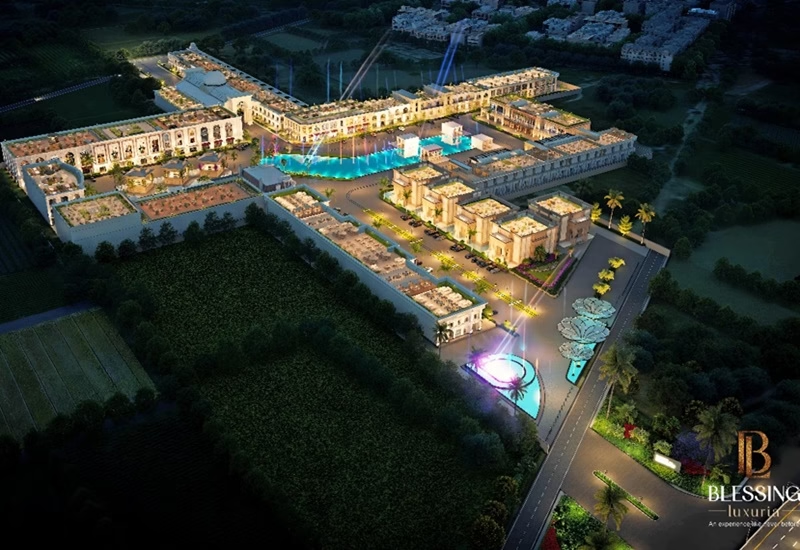
IMAGES Retail Bureau Blessing Luxuria is Ludhiana’s largest, most iconic high street commercial development, redefining the urban landscape with its world-class European high street concept. Spanning 18.60 acres in South City—the city’s most prestigious and high-footfall location—this next-generation project is a benchmark in design, scale, and experience. With only construction on 24% of the total land and rest if the open area for amenities. Led by legendary architect Hafeez Contractor, with master planning by Nisar Ahmed, architectural finesse by Zaffer Chaudhary, lighting design by Basur Ji, and landscaping by PLA Landscape (Thailand & Singapore), Blessing Luxuria is a seamless collaboration of global talent. Drawing inspiration from internationally celebrated landmarks, it combines aesthetic grandeur with functional elegance. The development is envisioned as a vibrant hub for Retail, F&B, Fine Dining, Leisure, and Entertainment, featuring premium spaces for cafés, lounges, bars, restaurants, and high-end brands. Unique experiential amenities include a 2.5-acre water lagoon, musical fountains, gondola rides, daily curated events, a tram, golf-carts, air-conditioned corridors, and over 3000 parking spaces. The project also introduces innovations like hands-free shopping and five-star driver lounges. The Differentiators “We aim to differentiate our High-street project by offering a unique blend of experiences that go beyond traditional retail. Our focus is on creating a dynamic lifestyle destination that combines shopping, dining, entertainment, and community engagement. Some key points are as below,” explains Himanshu Kwatra, Director, Western Living Pvt. Ltd. “The project brings a cosmopolitan European high street feel to Ludhiana, combining open-air vibrancy with luxury shopping and leisure experiences,” he adds. Blessing Luxuria is setting a new benchmark for scale and ambition with its ultra-premium, first-of-its-kind features and amenities in Ludhiana. These include: A 2.5-acre water lagoon Gondola rides & musical fountains Tram transport within the premises Air-conditioned corridors Five-star driver lounges with vending & LED screens 30 golf carts Aside from these, the mall will also feature a director’s cut cinema, an indoor gaming zone, kids’ play areas, seasonal attractions, and an outdoor plaza—alongside diverse dining options including global chains, gourmet restaurants, local eateries, trendy cafés, dessert bars, and a spacious food court—all curated to deliver vibrant, family-friendly, and memorable social experiences. Uniquely curated daily events and activations ensure continuous engagement and sustained foot traffic throughout the year. A First-of-Its-Kind Brand Revolution Located in the heart of South City, Ludhiana’s most upscale and high-density area, Blessing Luxuria is surrounded by a premium catchment area –affluent residential zones, home to over 5,000 posh families, with an additional 4,000+ high-rise apartments and 4,500+ plotted homes under development, ensuring a robust and ready business demand. The development is committed to introducing several national and international brands making their first-ever entry into Ludhiana, transforming the city’s commercial profile. Using Technology to Create an Unmatched Consumer Experience Blessing Luxuria features tech-enabled retail, with its incorporation of hands-free shopping and an in-built mobile application, elevating the digital-retail integration and customer convenience. Technology plays a central role in both the operation of the mall and in delivering a seamless, engaging experience for visitors. A range of smart and digital innovations designed to enhance convenience, efficiency, and personalisation have been integrated alongside key technology and smart innovations which include a real-time smart parking system, a feature-rich mobile app with indoor navigation and personalised offers, interactive digital directories, free high-speed Wi-Fi, AI-powered analytics for operational insights, IoT-based smart energy management, dynamic digital signage, and fully contactless services. “Blessing Luxuria is designed to deliver a seamless, luxury-driven retail journey. Visitors can pre-book parking slots via our in-built app, arrive and park effortlessly, and move across the project in golf carts or a dedicated tram service,” says Kwatra. “Our hands-free shopping service allows guests to browse freely while their purchases are securely managed. Luxurious lounges and rest zones further enhance comfort, encouraging visitors to spend an entire day enjoying the space,” he adds. Curating the Right Tenant Mix Blessing Luxuria features a meticulously planned brand mix, curated by industry experts to optimize visitor engagement and business performance. The project offers a well-balanced zoning strategy with 60% dedicated to retail and 40% to F&B, creating a dynamic environment that caters to both everyday needs and lifestyle aspirations. From boutique flower shops to luxury automobile showrooms, every category finds a home here. “Curating the tenant mix was a carefully planned process grounded in market research, consumer behavior analysis, and long-term commercial strategy. Our goal was to create a balanced, dynamic mix of tenants which appeals to a broad customer base while ensuring long-term viability and diversity in offerings. Visitors can expect a diverse range of offerings including international and regional fashion brands, home décor and electronics stores, global and local dining options, as well as entertainment features like a cinema, family zones, and experiential attractions—all catering to varied tastes and lifestyles,” states Kwatra. Expansion Plans Even as the project is all set to launch in December 2025, future expansion plans are already being laid out. These include proposals to introduce experiential zones such as virtual reality entertainment, interactive kiosks, and pop-up events to keep the environment dynamic. Plans are also in consideration for upgrading technology infrastructure for smart parking, advanced security systems, and integrating digital way finding. Additionally, expanding dining options with rooftop cafes and open-air lounges is under consideration. Seasonal and cultural events, along with collaborations with local artists, aim to keep the mall vibrant and engaging. Over the next 3 to 5 years, our long-term goals for Blessing Luxuria focus on establishing it as a landmark commercial destination and ensuring sustained growth, relevance, and customer loyalty. Key objectives include: Achieving Full Occupancy – Attracting a strong mix of global and local brands across retail, F&B, and entertainment to create a vibrant tenant ecosystem. Becoming a Regional Retail Hub – Positioning Blessing Luxuria as a go-to destination not just for shopping, but for lifestyle experiences, drawing visitors from across the region. Continuous Innovation – Integrating emerging technologies such as AI, AR/VR experiences, and data-driven retail solutions to enhance customer engagement and mall operations. Sustainability Leadership