
As Gurugram Claims 63% of Q4 Leasing, Experience-Led Retail Takes Center Stage

Authored By: Siddharth Singh, Head- Leasing, Felix Plaza Retail in NCR is entering a new phase, one where time spent is becoming more valuable than square footage leased. While India continues to rank among the fastest-growing retail markets globally, with organised retail penetration steadily rising and NCR leading Grade A supply additions, the underlying shift is more nuanced. In Q4 2025, retail leasing in Delhi NCR stood at 1.03 msf, an increase of 100% QOQ and 4.5x on a YOY basis, as per the data released by Cushman and Wakefield. Gurugram led the overall retail leasing during Q4-25 with a 63% share. Mainstreets accounted for 55% of annual leasing, while malls witnessed 45% of total space take-up. F&B led the space take-up in 2025 with a 22% share, followed by fashion (21%) and department store (14%) segments. Leasing by the F&B, entertainment and consumer durables segments has almost doubled in 2025 as compared to last year. In Gurugram, leasing momentum is increasingly being driven by experiential formats: chef-led dining concepts, wellness studios, boutique fitness, and immersive flagship stores, rather than traditional anchor-led models alone. The modern consumer, particularly in affluent micro-markets, is not merely shopping; they are seeking social currency, community interaction, and curated discovery. Moreover, Gurugram’s next phase of retail growth is unfolding beyond its legacy hubs. While MG Road and CyberHub continue to anchor the city’s established retail map, leasing conversations are shifting toward decentralised micro-markets such as Golf Course Extension Road, SPR Road, the Dwarka Expressway belt and sectors in New Gurgaon. Developers and retailers say the logic is straightforward: retail is following rooftops– but more importantly, it is following aspiration density. As luxury residential clusters and Grade A office developments expand outward, they are creating what industry insiders describe as “experience gravity zones” where premium housing, corporate footfall and rising disposable incomes combine to generate consistent evening and weekend demand. Within this decentralised shift, Sector 82A is emerging as a strategic location rather than just another plotted grid on the Gurugram map. Located at the intersection of the Dwarka Expressway and the NH-8 corridor, and embedded within New Gurgaon’s high-density luxury residential belt, the sector benefits from a catchment that is both affluent and untapped. Thousands of premium housing units are either occupied or nearing completion in the surrounding Sectors 80–95, yet organised retail supply in the immediate vicinity remains limited, creating a clear demand-supply gap. The connectivity multiplier further strengthens the proposition: the operational momentum of the Dwarka Expressway, seamless access to Delhi and IGI Airport, and proximity to emerging office pockets lend infrastructure-backed confidence to retail investments. For developers and brands, the opportunity lies in the early-mover premium, establishing a high-quality, experience-led retail destination in a maturing residential hub before the market reaches saturation and competitive clutter. Besides, mixed-use development is increasingly being viewed not as an architectural ambition but as structural risk management. Developers believe integrating office, residential, retail and hospitality components within a single ecosystem creates what can be described as a “live-work-play loop”. Office occupiers generate weekday lunch and post-work footfall; residents sustain evening and weekend consumption; curated retail and hospitality formats activate the ground plane throughout the day. This cross-utilisation of catchments smoothens revenue volatility and reduces vacancy cycles, offering what industry stakeholders call built-in footfall insurance. Alongside mixed-use integration, the traditional enclosed mall is gradually giving way to open, street-facing formats designed around walkability and public engagement. Developers are prioritising breathable plazas with natural light, cross-ventilation, outdoor seating and activated public realms over inward-looking corridors. Post-pandemic consumers continue to value perceived safety and open-air environments, where natural ventilation translates into subconscious comfort. At the same time, curated streetscapes and “Instagrammable” facades are becoming organic marketing tools, driving footfall beyond paid promotions. Industry observers describe this as the rise of a modern piazza culture where retail functions less as a transactional corridor and more as social theatre. Taken together, these shifts signal a structural reset rather than a cyclical upswing. Retail in NCR, and particularly in Gurugram, is no longer being planned around anchor boxes and parking ratios alone; it is being designed around dwell time, community engagement and lifestyle alignment. As micro-markets such as Sector 82A mature alongside infrastructure upgrades and premium residential expansion, the opportunity lies in creating destinations that integrate hospitality, open public realms and mixed-use ecosystems into a single, cohesive narrative.
REITs market projected to reach Rs 19.7 tn by 2030, powered by retail, warehousing: Knight Frank India
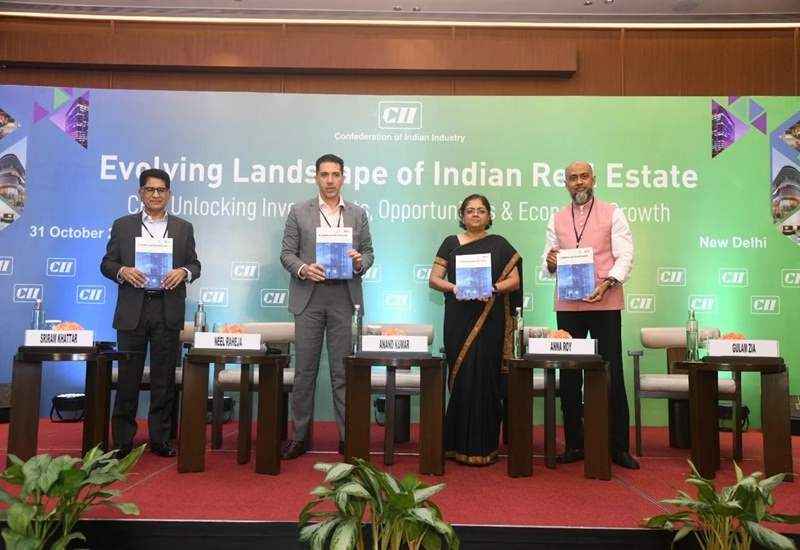
Knight Frank India, in collaboration with the Confederation of Indian Industry (CII), today unveiled its latest report, Commercial Real Estate: Potential is Built, Opportunity is Now, at the CII Conference on Evolving Landscape of Indian Real Estate – CRE: Unlocking Investments, Opportunities & Economic Growth. The report positions India’s commercial real estate (CRE) sector at a defining juncture, where its built potential is set to translate into tangible growth. Among its key highlights, India’s REIT market is projected to reach INR 19.7 tn by 2030 (from INR 10.4 tn in 2025), driven by high occupancy, favourable taxation, and broader sectoral inclusion. Private equity participation, rising from USD 500 mn in 2011 to multi-billion-dollar highs by 2019, has enhanced transparency, deepened institutional confidence, and paved the way for REIT expansion across India’s thriving CRE landscape. As urbanisation, technology, and progressive policy reforms continue to reshape the sector, India’s CRE stands poised to unlock the next wave of opportunity across asset classes. Retail consumption across the organised formats is estimated at a value of INR 8.8 Tn for FY 2025. Led by shopping centres (INR 4.9 tn), high streets (INR 3.8 tn), and other new-age formats such as airport and transit retail. This expansion reflects a clear shift toward experience-driven, consumer-centric destinations where shopping intersects with lifestyle and leisure. Shishir Baijal, Chairman and Managing Director, Knight Frank India, said, “India’s CRE transformation is being led by businesses that are more global, technology-driven and experience-focused than ever before. Consolidation in office demand, resilient retail growth and the rapid expansion of digital infrastructure have fundamentally reshaped occupier behaviour. Today, companies want efficient, green, future-ready spaces, and capital markets are rewarding that shift. As India heads toward a USD 7 tn economy, CRE will play an essential role in powering productivity, attracting investment and building next-generation urban centres.” REITs: Deepening Market Participation India’s REITs have a potential to diversify beyond traditional asset classes like office, retail, and warehousing, to industrial parks, data centres, and hospitality. Listed REITs have delivered stable average annual dividend yield of about 5.5%, making them attractive income-generating vehicles. By 2030, India’s REIT market (including office, retail and warehousing sectors) is projected to reach INR 19.7 tn. India currently has five listed REITs covering about 177 mn sq ft of commercial and retail space spanning operational, under-construction, and upcoming assets worth approximately INR 2.3 tn with over 290,000 unitholders. Office REITs India’s office REITs account for just 15.3% of the total office stock across the top eight cities[1], signalling strong potential for institutional growth. Demand from Global Capability Centres (GCCs) and India-facing businesses continues to strengthen, supported by a steady leasing pipeline and occupier preference for premium, sustainable workspaces. The value of REIT-able office assets is expected to rise from INR 8.2 tn in 2025 to INR 16.0 tn by 2030, nearly doubling in five years. With substantial prime office assets yet to enter REIT structures, broader participation from developers and investors will define the next growth phase for India’s office REIT market. Retail REITs Retail REITs are emerging as a new frontier for India’s real estate market amid a strong revival in organized retail. With only 7.3 mn sq ft of Grade A stock currently under REITs, out of a total of 66 mn sq ft of Grade A stock, there is significant headroom for institutional expansion. The value of REIT-able retail assets is projected to grow from INR 1.5 tn in 2025 to INR 2.4 tn by 2030, driven by rising consumer demand and the shift toward formal retail formats. As malls, lifestyle hubs, and mixed-use developments proliferate, retail REITs offer a structured, transparent way for investors to participate in India’s consumption-led growth story. Warehousing and Industrial REITs Warehousing has emerged as one of the most promising future avenues for REITs in India. Fuelled by e-commerce and third-party logistics (3PL) growth, leasing activity reached 32.1 mn sq ft in H1 2025. The top eight warehousing markets collectively hold 220.9 mn sq ft of Grade A stock, offering vast institutional potential. As technology-enabled, high-quality logistics facilities gain traction among occupiers, industrial and warehousing REITs or InvITs are expected to be launched in the next few years. Value of REIT/InvIT can potentially grow from INR 0.7 tn to INR 1.3 tn by 2030. Neel Raheja, Chair, CII National Committee on Real Estate & Housing, and Group President, K Raheja Corp, said, “The partnership between CII and Knight Frank underscores a shared commitment to advancing India’s built environment. As commercial real estate matures, it will play a pivotal role in shaping investment flows, employment, and urban transformation. The sector’s progress mirrors India’s broader economic journey—where potential is abundant, and the time to seize opportunity is now.” Office: Navigating Supply Constraints and Unlocking Growth India is world’s fourth largest office market (valued at INR 16.4 tn (USD 186 bn) and now it has crossed the 1 bn sq ft milestone in 2025. Over two decades, office stock expanded at a CAGR of 8.6%, underscoring structural resilience and sustained investor appetite. Between 2008 and 2024, gross leasing activity grew 5% CAGR, while new completions rose just 1%, tightening the supply-to-demand ratio from 1.40 in 2008 to 0.49 in 2025. The report notes that several top developers have shifted focus to residential projects for higher margins and quicker returns, deepening supply constraints. To achieve the next milestone of 2 bn sq ft, India’s office sector must blend expansion with optimisation through policy incentives, public-private partnerships/JVs and institutional capital. Integrating green certifications early in the planning process is increasingly seen as best practice, enhancing ESG alignment and unlocking additional FSI. Notably, 31% of existing office stock offers retrofitting potential, while 12% of SEZ assets can be adaptively reused, creating scope for sustainable growth. Retail: Experience, Scale, and Renewed Investor Confidence Across organised formats, retail consumption is estimated at a value of INR 8.8 tn for FY 2025, driven by the expansion of shopping centres, high streets, and emerging formats such as airport and transit retail. Since