
Mumbai strengthens its position as India’s data centre capital: Knight Frank

Mumbai records 97.6MW of take up in H1 2025 Vacancy rate tight at 5.4% despite robust new data centre supply Knight Frank, in its latest report, Asia-Pacific Data Centres 2025, highlights Mumbai’s rise as India’s data centre capital. According to the report, the city leads India’s data-centre landscape accounting for 40% of total national capacity and 44% of live IT capacity. In H1 2025, Mumbai’s capacity rose 14.3% to surpass the 4GW milestone, with 591MW operational, 185MW under construction, and 3.2GW in the pipeline. This growth builds on India’s data centre market surpassing 10GW in H2 2024, supported by 1.4GW live and 400MW under construction. Rapid cloud adoption, increasing data localisation requirements, as well as the growth of local fintech and BFSI firms has been fuelling data-centre demand. Over the past six months, Mumbai recorded 97.6MW of take-up. This has translated to a tight vacancy rate of just 5.4% vs. India’s overall colocation vacancy rate at 12.3%. Demand-side commitments seem resilient with absorption broadly keeping pace with the multi-fold growth in supply over the past years. Also, two-thirds of Mumbai’s capacity under construction at present is already pre-leased. Yet, with just three live sites currently capable of supporting hyperscale deployments (>2.5MW) and only one site with available capacity of more than 10MW, there seems to be a short-term supply tightness for big-ticket requirements. Distribution of available live capacity is skewed toward smaller deployments: 10 sites offer <1MW, 5 sites fall in the 1–2MW range, while only 3 sites provide >3MW. Such fragmented deployments are opening doors for well-capitalized global players and joint ventures to deliver high-capacity facilities in the region that is currently dominated by local players. The 500MW NAV2 campus announced by NTT and another 500MW AI facility by Blackstone-Panchshil Realty are case in point. Also, operators with large-scale requirements are exploring alternative markets. Hyderabad is positioning itself as a hyperscale-first market, with over 500MW of new data centre capacity currently in the pipeline through two projects. STT GDC India has signed an MoU with the Telangana government to develop a 100MW campus, while NTT has committed INR 10,500 crore (approximately USD 1.25 bn) to establish a 400MW AI-focused data centre campus. Hyderabad is the second largest data centre market in India with 2.1GW of total capacity, followed by Chennai (1.6GW), New Delhi (712MW) and Bengaluru (307MW). Shishir Baijal, Chairman & Managing Director, Knight Frank India, said: “Mumbai has firmly established itself as the epicentre of India’s digital infrastructure growth. With over 3GW of capacity in the pipeline and strong policy support for green data centre parks, the city is attracting sustained global investment. As cloud adoption and AI workloads accelerate, Mumbai’s unique strengths, its robust subsea cable connectivity, scalable power infrastructure, proximity to enterprise hubs, and progressive state policies are consolidating its position as India’s data centre capital. While other metros like Chennai, Hyderabad, and Bengaluru are gaining traction, none match Mumbai’s scale, speed, and ability to serve as South Asia’s gateway for cloud, AI, and enterprise workloads.” Regional Context In the first half of 2025, the APAC region secured nearly 13GW of new project announcements, a 160% increase and more than double the 5GW announced in the same period last year. The funding needed for these projects already exceeds US$180 billion. Major technology firms are driving much of this investment. Amazon is projected to exceed US$100 billion in capital expenditure for 2025, up from about US$82 billion last year, while Microsoft invested US$55 billion in 2024 and has committed more than US$33 billion this year. Collectively, Microsoft, AWS, Google, and Meta have committed over US$160 billion in 2025 alone, reflecting the intensity and scale of current infrastructure development. Fred Fitzalan, Head of Data Centres Asia-Pacific, Knight Frank says, “The sheer volume of new projects in the region highlights just how important the region has become in the global digital infrastructure landscape. However, coordinating this rapid growth is a complex challenge, as operators must keep pace with advances in technology and rising energy needs, all while ensuring new facilities are delivered in step with evolving demands.” Alongside the hyperscalers, GPU-as-a-Service providers are expanding rapidly, seeking multi-megawatt capacity across the region and bringing greater diversity into leasing conversations. Creditworthiness and shortened deployment timelines remain perennial challenges, but innovative guarantee structures are enabling some operators to compete effectively for new contracts. Fred Fitzalan adds, “What has become clear is the strict requirement for operators to design facilities with capacity that can be flexibly deployed for either Cloud or AI workloads, offering tenants maximum optionality. While this adds cost, it is now a decisive factor in site selection. Locations that combine proximity to parent sites with sufficient power allocations to support long-term runway are winning out, although this remains a significant challenge given national grid constraints and permitting delays in Tier 1 APAC markets.” Johor (located in Malaysia) established itself as Southeast Asia’s fastest-growing data centre hub, with aggregate supply nearly doubling over the last 12 months to 5.8GW in Q2 2025, including 2.0GW of new project announcements, backed by strong government support and the rollout of national Data Centre Planning Guidelines. Take-up: Johor recorded 260.0MW of take-up in the first half of 2025, with social media accounting for 61% and the remainder driven by AI demand. The market is now highly constrained, with a vacancy rate of just 1.1%, as planning becomes more challenging and power shortages coming through. Tokyo continues to hold its position as a key regional hub with aggregate capacity exceeding 4.2GW, a 2.7% increase on volumes recorded at the end of Q2 2024. Investment activity remains strong, highlighted by Ares completing a US$2.4 billion Japan-focused fund through Ada Infrastructure, while Mitsui & Co. Asset Management’s US$122 million acquisition signals sustained domestic investment appetite. Take up: Over the past six months, Tokyo recorded 41.1MW of capacity transacted. This is a slowdown from the first half of 2024, when 286.6MW was transacted, due to reduced supply in the market. Tokyo continues to be a tightly constrained market, with colocation
Smartworks achieves milestone with largest Mumbai campus, over 557,000 sq. ft. at Intellion Park
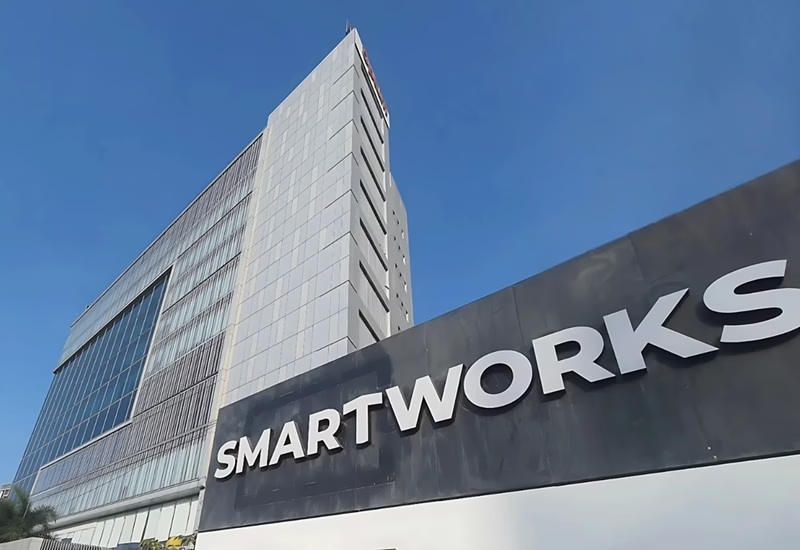
Smartworks Coworking Spaces Limited, one of India’s largest managed office platform by total area under management, has reinforced its leadership with over 557,000 sq. ft. campus at Intellion Park, Navi Mumbai, a marquee development by Tata Realty and Infrastructure Limited. Intellion Park is Smartworks’ largest managed office campus in Mumbai. With this addition, the company’s leased portfolio in Mumbai has crossed the 1 million sq. ft. milestone, a landmark achievement in India’s financial capital. Strategically located on the Thane Belapur Road, Intellion Park is poised to be the largest IT Park in Navi Mumbai. The micro-market is backed by a well-established social and physical infrastructure, offering excellent connectivity, thriving residential hubs, and access to a strong talent pool. The new campus is already attracting interest from marquee clients, drawn by its prime location and comprehensive amenities designed for workforce productivity. Commenting on the campus, Neetish Sarda- Managing Director & Founder, Smartworks, said: “Mumbai is a strategic market and enterprise demand here continues to accelerate across sectors. Intellion Park, our largest managed office campus in the city, is designed for enterprises that need scale, speed, and experience under one roof. Crossing over 1 million sq. ft. leased portfolio mark in Mumbai is not just a milestone, it reflects the deep trust enterprises place in our model and our ability to deliver at scale.” With pre-certifications including LEED Platinum, IFC Edge, and WELL Gold, the campus integrates solar power, smart automation, underdeck insulation, and high-efficiency LED lighting — delivering measurable reductions in energy use while supporting enterprise ESG goals. Sanjay Dutt, Managing Director & CEO, Tata Realty, said: “Our partnership with Smartworks, a proven leader in managed campuses, reflects a shared vision to create world-class, future-ready work environments. With Intellion Park set to become Navi Mumbai’s largest IT Park, and Smartworks’ expertise in building scalable, enterprise-grade campuses, this collaboration is poised to set new benchmarks in the region’s commercial real estate landscape.” As the category creator of the Managed Campus model, Smartworks combines scale with reliability. With Intellion Park added in Q1 FY26, the company has deepened its presence in Mumbai and reinforced its unmatched scale and leadership in the managed office category nationwide. Smartworks already has four large campuses in its portfolio, each exceeding 500,000 sq. ft., including its flagship ~700,000 sq. ft. campus at Vaishnavi Tech Park in Bengaluru. The company leases large bare-shell properties and transforms them into Smartworks-branded, fully serviced campuses with aspirational amenities such as cafeterias, gyms, sports zones, crèches, medical centres, and convenience stores. Its large campuses allow enterprises to expand seamlessly with custom layout, design, and tech-enabled offices delivered in just 45–60 days. Smartworks has a footprint of ~12 million sq. ft. across 14 cities in India and Singapore, serving 730+ marquee clients including Google, Persistent, Groww, EY, Xoriant, and Discovery. About Smartworks Coworking Spaces Limited Smartworks Coworking Spaces Ltd (‘Smartworks’) is the largest managed office platform by total area under management ~12 million sq. ft across 14 cities in India and Singapore. The company serves as a one-stop workspace solution for companies. The company leases entire/large bare shell properties in prime locations from landlords and transforms them into fully serviced, ‘Smartworks’ branded, and tech-enabled Campuses with daily-life and aspirational amenities —cafeterias, sports zones, convenience stores, gyms, crèches, and medical centres. Smartworks focusses on mid-to-large Enterprises and has a diverse client base of over 730, which includes Forbes 2000 companies, MNCs, Indian conglomerates and startups.
6 parks planned to position Maharashtra as Technical Textile leader: Minister Sanjay Savkare

Sanjay Savkare, Minister of Textiles, Government of Maharashtra said that the Maharashtra Government, through its policy measures, is focusing on attracting domestic and foreign investment and providing support on skilling, R&D and infrastructure development to build globally competitive textile & apparel industry in the state. He stated that authorities are working towards establishing 6 technical textile parks, one in each of the revenue divisions, to make Maharashtra a hub for Technical Textiles. Speaking at a FICCI event, Sanjay Savkare added that state has set up a task force to seek suggestions from stakeholders to enhance the export competitiveness of Maharashtra as well as gain suggestions on the support that the Textile Industry can expect. The event saw the release of the FICCI–Wazir Advisors Textile industry report, ‘Catalysing Textile & Apparel Growth: Leveraging Global Opportunities’. Anshu Sinha, Principal Secretary (Textile), Government of Maharashtra also spoke on the need for collaboration and collective efforts of industry, academia and government to further strengthen Maharashtra’s position as a leading textile manufacturing hub, while seeking support of the industry in the areas of skilling, R&D and sustainable practices. Prashant Agarwal, Joint MD, Wazir Advisors shared a brief overview of FICCI – Wazir Advisors Report, which takes stock of the global and Indian textile & apparel (T&A) landscape in a year marked by geopolitical uncertainty, shifting trade flows, rapid advances in sustainability and innovation, and the challenges arising from the US reciprocal tariff scenario. The report also talks about what strategies India can adopt to fully realize its potential and position itself as a leading global hub. The report states that Global textile & apparel trade reached ~US$ 893 billion in 2024, reflecting 5% growth over the previous year, with China retaining one-third share. The global apparel market, now at US$ 1.8 trillion, is projected to touch US$ 2.3 trillion by 2030. India, with a US$ 184 billion domestic T&A market and US$ 37 billion in exports (FY25), continues to hold strong fundamentals but faces challenges from newly imposed US tariffs of 50%, compared to lower rates for competitors like Bangladesh and Vietnam. The report identifies garmenting investments as the central lever for India’s next phase of growth, supported by FDI inflows, global alliances, and government schemes like PLI and PM MITRA Parks. It highlights how forward integration into apparel manufacturing can enhance value addition, create large-scale employment, and improve India’s competitiveness as an end-to-end sourcing hub. It also emphasises innovation and sustainability as twin imperatives—ranging from smart textiles, eco-friendly materials, and digitalized supply chains to scalable adoption of green manufacturing practices. It further underlines India’s factor cost advantages over peers, while cautioning that weak R&D and lack of FTAs with key markets remain bottlenecks. The way forward, according to the whitepaper, rests on market diversification beyond the US, policy stability, infrastructure development, R&D and skilling, and embedding sustainability across the value chain. By combining investment-led growth with innovation and global partnerships, India can not only withstand tariff headwinds but also position itself as a leading global sourcing destination by 2030.
Awfis launches new 50000 sq ft. centre in Supreme Business Park, Powai

Awfis Space Solutions Limited, one of India’s largest and first publicly listed workspace solutions company, has announced the launch of its new centre spanning ~50000 sq ft. chargeable area in Supreme Business Park, Hiranandani Gardens, Powai. The location offers strong connectivity through multiple transport modes, including upcoming metro lines, key arterial roads, and proximity to the airport and railway stations, making it one of Mumbai’s most accessible and upscale areas. With this expansion, Awfis now operates 35 centres in Mumbai, offering ~1.04 million. sq. ft. serving a diverse clientele across sectors and demographics. The centre is already occupied by Howden Insurance Brokers India Pvt. Ltd., a leading independent insurance and reinsurance intermediary. Howden has taken ~ 36,000 sq. ft. with a 60-month lease agreement—reflecting Howden’s long-term commitment to Awfis. Large enterprises account for 59% of Awfis’ client base, complemented by a healthy mix of mid- and small-sized occupiers, ensuring a well-balanced demand portfolio. Commenting on this development, Amit Ramani, Chairman and MD, Awfis Space Solutions Ltd., said, “Mumbai continues to flourish as India’s financial capital, driven by strong CRE growth, the influx of global capability centres, and the rising demand for high-quality Grade A office spaces. As more enterprises look to set up and expand operations in the city, we are proud to be contributing to this growth by offering innovative coworking formats, managed offices, and custom-built solutions that cater to diverse business needs while redefining the future of work. We are delighted to partner with Howden Insurance Brokers India Pvt. Ltd., one of India’s leading insurance brokers, in setting up their new office at our new Powai centre. This win reaffirms our position as the preferred workspace partner for enterprises seeking future-ready, flexible, and scalable office solutions in prime business districts.” With 73% of Awfis’ clients having tenures exceeding 24 months, the company has demonstrated strong retention and long-term trust, while a robust pipeline of new clients continues to drive portfolio growth. India continues to emerge as a preferred global destination for corporate real estate requirements, with demand driven by major metros—Mumbai alone accounting for 20% of the growth. The office market outlook remains positive, underpinned by India’s resilient economic fundamentals and the continued expansion of global capability centers (GCCs). The demand for flexible and sustainable workspace is expected to further shape market dynamics, with occupiers increasingly seeking tech-enabled and ESG-compliant office solutions. Building on this momentum, Awfis is reinforcing its leadership in Mumbai’s coworking and managed office market, serving enterprises, startups, and professionals through a comprehensive suite of solutions spanning enterprise workspaces, allied services, and design & build capabilities across India.
Bhumika Realty enters UP East, names Amit Tewari as Head of Sales for Lucknow & Ayodhya

Bengaluru: After establishing a strong presence in Rajasthan and expanding into Delhi-NCR, Bhumika Realty has entered Eastern Uttar Pradesh, with real estate projects planned in Lucknow and Ayodhya. With integrated townships and mixed-use developments in the pipeline, the move marks a key step in the company’s goal to expand across North India in residential, commercial, retail, and hospitality segments. “Eastern Uttar Pradesh is witnessing a sharp rise in infrastructure investments and urban migration,” said Uddhav Poddar, Chairman and Managing Director, Bhumika Group. “We see this as a timely opportunity to bring our brand of responsible, design-led development to the region.” To support this growth, the company has appointed Amit Tewari as Head of Sales – Lucknow & Ayodhya. With nearly 20 years of experience at companies like DLF, Omaxe, Synergy Advisors, and Prominent Enterprises, Tewari brings deep expertise in real estate sales, revenue strategy, and market development. “As we deepen our presence in high-potential markets, the ability to scale with agility becomes essential,” said Siddharth Katyal, CEO, Bhumika Realty. “Tewari’s proven track record in building high-performance teams and navigating diverse market dynamics makes him a valuable addition to our leadership team.” “Bhumika Realty’s integrated and customer-centric approach is well-positioned to shape the next chapter of growth in UP East. I look forward to enabling meaningful expansion in the region by delivering quality-driven, future-ready real estate solutions,” added Tiwari. With successful commercial and retail developments such as Urban Square Mall in Rajasthan, Bhumika Realty is now laying the groundwork for a broader northern expansion, beginning with Lucknow and Ayodhya, and with additional UP cities under evaluation.
The Compact Conquest: How neighbourhood malls are reimagining urban retail

For years, Indian retail was measured in size; the bigger the mall, the bigger the bragging rights. But walk through Delhi-NCR today and you’ll notice something changing. Compact neighbourhood malls are emerging in areas such as Noida Extension, Dwarka, and Gurugram’s new sectors and high-density areas, designed to seamlessly integrate into daily life. The idea is simple. People no longer want to drive an hour, hunt for parking, and spend half a day in a mall just to pick up groceries and catch a film. Post-pandemic habits have reinforced this. Shoppers prefer retail that sits closer to home, within a 10–15-minute drive. Knight Frank’s latest study highlights that dense micro-markets are now the primary drivers of retail growth. These malls usually range between 50,000 and 200,000 sq ft with a high-quality supermarket at the centre, surrounded by a few F&B brands, salons, wellness clinics, a play zone or a small multiplex, plus essential services like banks and pharmacies. It’s enough to keep footfalls steady throughout the week. CBRE data shows retail leasing in India shot up nearly 50% in 2023, and a significant chunk was driven by new malls of this scale. According to a recent report by Cushman & Wakefield, retail leasing in high streets across Delhi-NCR jumped a massive 57% year-on-year in Q1 2025, accounting for 61% of the region’s total leasing activity. Gurugram led the way, followed by Noida and Delhi. Much of it was driven by neighbourhood malls. Pankaj Jain, Founder & CMD, SPJ Group, says, “Neighbourhood malls are redefining the urban retail landscape by combining convenience with community. He notes that design and layout play an integral role in a retail project’s success: “Developers are realising that the format must look and feel different from the boxy malls of the 2000s. Curated is the keyword. People don’t want 200 stores. They want a clean, walkable space where the mix of tenants feels right. With evolving lifestyles and a growing preference for hyperlocal experiences, we are seeing increasing fondness for these formats as they deliver both footfall consistency and a sense of belonging for residents. For developers, this is not just about building retail spaces, but about creating vibrant social hubs that enhance liveability. In our project design, we are particular in designing them for everyday use, but with enough character to become the go-to social spot. That’s how you build loyalty.” Arjun Gehlot, Director, Ambience Malls, says, “The ability to tailor tenant mix is another edge. As cities like Gurugram continue to evolve, malls here are shaping up as cultural and social hubs that define urban living. The city’s purchasing power now rivals that of Delhi, which makes it an attractive destination for both consumers and brands. This has created a natural pull for top international retailers who now see Indian malls as the most strategic entry point to connect with an aspirational and diverse consumer base. Global fashion and lifestyle names coexisting alongside national brands and even familiar neighbourhood favourites offer a holistic experience that feels both world-class and rooted in community.” Ajendra Singh, VP, Sales & Marketing, Spectrum@Metro, says, “For developers, the case is practical as much as it is strategic. Smaller malls don’t tie up capital for years, and leasing cycles are quicker. More importantly, they tap into a ready-made catchment of residents. Post-pandemic behaviour has made this model stronger. People want F&B and essential retail right next door. For us, it creates value on both sides, our housing projects get a retail anchor, while the mall itself finds tenants faster and delivers steady yields.” Across India, from Bengaluru’s Whitefield to Mumbai’s suburbs, similar stories are playing out. But NCR’s density and township-led growth may make it the testing ground for the model. Analysts point out that as the region sprawls further outward, compact retail will be the backbone of these self-contained ecosystems. So while the big malls will always have their place on the weekends, it’s the compact neighbourhood centre that is fast becoming the workhorse of urban retail. In NCR, especially, that shift is visible every time a new township opens, and almost immediately, a neighbourhood mall rises to complete it.
Group 108’s 23-Acre Grandthum gets part CC; 1300 customers to receive possession

Noida-based realty player, Group 108, has received Part CC for its flagship project, Grandthum, in Greater Noida West. This milestone paves the way for over 1300 customers to begin receiving possession, reaffirming Group 108’s commitment to fulfilling its delivery promise and quality execution. Spread across 23 acres (approx.), Grandthum brings together signature office spaces, high-street retail, multiplex, dining, and leisure zones into a unified ecosystem. Since its launch in 2019, the development has emerged as a landmark in NCR’s commercial real estate landscape. Its twin signature office towers (G+34 and G+30 floors) come with Sky Deck on the 27th and 28th floors, offering panoramic views of the region. Adding to its appeal is a vibrant 8 lakh sq. ft.(approx.) high-street retail promenade with more than 100 outlets, a five-screen multiplex with 900 seating capacity, and zones dedicated to QSRs, High Energy bars, and experiential leisure. One of Grandthum’s most distinctive highlight is its Yacht Garden, an open-air zone with an approx two-acre water body, landscaped sit-outs, and lush green promenade designed to elevate the visitor experience. The project also offers multi-level car parking, three-tier security, high-speed escalators, and uninterrupted power backup, ensuring convenience and comfort at every touchpoint. Dr. Amish Bhutani, Managing Director, Group 108, said, “Receiving the Part CC for Grandthum and offering possession to more than 1,300 customers is a proud achievement for us. From the very outset, our vision was to create a development that is not only limited to real estate but becomes a complete ecosystem for work, retail, and leisure. This milestone reflects our unwavering commitment to quality, execution excellence, and our promise to deliver spaces that create long-term value for our customers.” Sanchit Bhutani, Managing Director, Group 108, added, “Securing Part CC further strengthens Grandthum’s position as one of NCR’s most prominent commercial developments, at a time when Noida–Greater Noida is witnessing strong interest from global businesses and MNCs. With world-class office infrastructure, a dynamic retail promenade, and lifestyle-driven offerings, Grandthum is well-placed to cater to the evolving needs of enterprises and communities alike. This is not just a regulatory milestone—it is the realization of our vision to establish a future-ready business and lifestyle hub for the region.” With over 60 marquee national and international brands on board, Grandthum is cementing its position as a premier destination for shopping, recreation, and community experiences. The project is also IGBC Platinum Pre-Certified, underscoring Group 108’s commitment to sustainability, energy efficiency, and responsible development. With its prime location near the upcoming Jewar International Airport, excellent connectivity to Noida, Delhi, and Ghaziabad, and proximity to a large catchment of over a few lakh families, Grandthum is set to emerge as one of NCR’s most vibrant and future-ready commercial destinations.
RERA reshapes India’s housing market, instills higher investor confidence: Knight Frank India
Knight Frank India, a leading real estate consultancy, together with NAREDCO, has launched its new report RERA’s Reign – Charting Real Estate Growth Post-2016, which examines the Act’s transformative role in India’s housing market. The report highlights how the Real Estate (Regulation and Development) Act, 2016 (RERA) has transformed India’s housing market by instilling transparency, discipline, and long-term confidence. It showcases that RERA has successfully moderated runaway housing prices while restoring consumer trust and attracting institutional capital to the sector. According to the report, with the implementation of RERA, speculative pricing in the housing market was brought under effective checks and balances. This policy intervention played a central role in aligning price growth with market fundamentals. Over time, with due processes in place and business restructuring on the supply side, the residential property market in India registered the much awaited growth post the last down cycle. Shishir Baijal, Chairman & Managing Director, Knight Frank India, said, “RERA has been one of the most impactful reforms for India’s housing market in recent times, making the sector more transparent and instilling accountability. Transparency and delivery discipline have given consumers the confidence to return to the market, while institutional investors are once again viewing residential real estate as a credible long-term investment story. This renewed balance in India’s housing market will go a long way in achieving sustainable growth.” The implementation of RERA has helped shift the housing sector away from speculative cycles, forcing developers to adopt compliance, transparency, and delivery-focused practices. For consumers, the result has been fairer pricing and renewed confidence in housing as a stable asset class. Investor Confidence Peaks Alongside improved affordability, investor confidence in Indian real estate has climbed steadily in the post-RERA era. The report highlights that cumulative private equity inflows surged to USD 26 bn between 2017–2020, compared to just USD 17.5 bn during 2011–2016. This influx of institutional capital reflects greater trust in the sector’s regulatory environment, signaling the success of RERA in building a more credible investment landscape. The performance of the NIFTY Realty Index further demonstrates this trend, showing stability and resilience in the post-RERA years. Large investors, once wary of opacity and delayed delivery, now view Indian real estate as a more predictable and disciplined market. According to the report, this structural shift has positioned India’s housing market as a long-term investment destination for both domestic and global players. RERA’s National Footprint Beyond prices and investments, RERA’s scale of implementation underlines its importance as the backbone of India’s housing market. By mid-2025, nearly 1.5 lakh projects and 1 lakh agents had been registered under the Act, while 1.5 lakh consumer complaints were successfully resolved This regulatory reach demonstrates not only the seriousness of RERA’s enforcement but also its growing acceptance among homebuyers and developers alike. For the first time, Indian homebuyers have had recourse to a structured grievance redressal mechanism, and developers have had to align their practices with strict compliance standards. The result has been a more transparent housing market, where accountability, timely delivery, and financial discipline are no longer exceptions but expectations. Saurabh Mehrotra, Executive Director–Valuation & Advisory, Knight Frank India, said, “For investors, this regulatory environment has helped create transparency and credibility in the residential sector, as reflected in the USD 26 bn private equity inflows since 2017. Since its inception, RERA has resolved 1.5 lakh consumer complaints while regulating projects and agents at scale. It has firmly established itself as the backbone of India’s residential real estate sector.” G Hari Babu, President, NAREDCO, said, “Over the past eight years, RERA has been nothing short of a game-changer for Indian real estate. As highlighted in the Knight Frank report at the 17th NAREDCO National Convention, housing sales in India touched an all-time high of ₹3.1 lakh crore in 2024, and nearly 1.5 lakh projects and 1.5 lakh consumer complaints have already been addressed under the RERA framework. This journey from opacity to transparency has rebuilt the trust of homebuyers, lenders, and global investors alike. The next step must be to evolve RERA into a more uniform, technology-driven framework across states so that the sector continues to be a backbone of India’s economic rise.” While RERA has laid a strong foundation, the report notes that more work remains to be done. Strengthening enforcement across states, harmonizing compliance frameworks, and adopting a “One Nation, One RERA” model will be critical to further enhance transparency and efficiency The report also recommends leveraging technology to streamline approvals and grievance redressal, alongside continued alignment with global best practices in real estate regulation. With India’s housing demand projected to rise steadily in the coming decade, sustaining confidence through consistent policy enforcement will be key. The data and insights presented in RERA’s Reign – Charting Real Estate Growth Post-2016 confirm that the Act has been a game changer for Indian housing. It has moderated prices, boosted investor confidence, and empowered consumers at an unprecedented scale. As RERA evolves into its next phase, it is poised to remain the cornerstone of India’s real estate growth story.