
Bengaluru, Mumbai, Delhi among top 15 global prime residential markets: Knight Frank
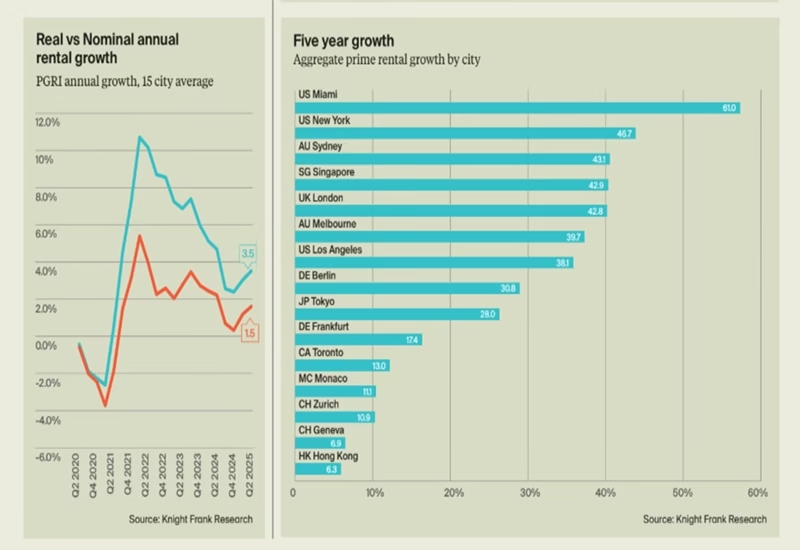
Knight Frank’s latest Prime Global Cities Index (PGCI) Q2 2025 reveals that Indian prime residential markets continue to outperform many global peers, with Bengaluru (10.2%), Mumbai (8.7%), and Delhi (3.9%) ranking within the top 15 among 46 global cities tracked. Despite a global cooling in prime residential price growth—averaging 2.3% annually compared to 3.5% in Q1 2025—Indian cities remain resilient, reflecting strong demand, limited prime supply, and sustained wealth creation in urban centres. Globally, Seoul led the rankings with 25.2% annual growth, followed by Tokyo (16.3%) and Dubai (15.8%). Bengaluru secured the 4th position worldwide, with Mumbai and Delhi at 6th and 15th respectively. Shishir Baijal, Chairman & Managing Director, Knight Frank India, said, “India’s prime residential markets have shown remarkable resilience, standing out in a year when global growth momentum has eased. Bengaluru’s tech-driven wealth creation, Mumbai’s renewed infrastructure-led appeal, and Delhi’s steady luxury demand have collectively kept India in the global spotlight. We anticipate that continued economic stability, urban redevelopment, and the appeal of prime assets as long-term wealth stores will support price growth in the months ahead.” Liam Bailey, Knight Frank’s Global Head of Research, commented, “Prime markets are taking a collective breath. The recovery we have seen over recent quarters was aided by the expectation of lower borrowing costs, and with that timeline now pushed out, a cooling in price growth is inevitable. We’re seeing a more fragmented market, with some European cities showing surprising strength while former high-flyers in Asia begin to level off.” The Prime Global Cities Index is a valuation-based index tracking the movement of prime residential prices across 46 cities worldwide using data from Knight Frank’s global research network.
Mumbai strengthens its position as India’s data centre capital: Knight Frank

Mumbai records 97.6MW of take up in H1 2025 Vacancy rate tight at 5.4% despite robust new data centre supply Knight Frank, in its latest report, Asia-Pacific Data Centres 2025, highlights Mumbai’s rise as India’s data centre capital. According to the report, the city leads India’s data-centre landscape accounting for 40% of total national capacity and 44% of live IT capacity. In H1 2025, Mumbai’s capacity rose 14.3% to surpass the 4GW milestone, with 591MW operational, 185MW under construction, and 3.2GW in the pipeline. This growth builds on India’s data centre market surpassing 10GW in H2 2024, supported by 1.4GW live and 400MW under construction. Rapid cloud adoption, increasing data localisation requirements, as well as the growth of local fintech and BFSI firms has been fuelling data-centre demand. Over the past six months, Mumbai recorded 97.6MW of take-up. This has translated to a tight vacancy rate of just 5.4% vs. India’s overall colocation vacancy rate at 12.3%. Demand-side commitments seem resilient with absorption broadly keeping pace with the multi-fold growth in supply over the past years. Also, two-thirds of Mumbai’s capacity under construction at present is already pre-leased. Yet, with just three live sites currently capable of supporting hyperscale deployments (>2.5MW) and only one site with available capacity of more than 10MW, there seems to be a short-term supply tightness for big-ticket requirements. Distribution of available live capacity is skewed toward smaller deployments: 10 sites offer <1MW, 5 sites fall in the 1–2MW range, while only 3 sites provide >3MW. Such fragmented deployments are opening doors for well-capitalized global players and joint ventures to deliver high-capacity facilities in the region that is currently dominated by local players. The 500MW NAV2 campus announced by NTT and another 500MW AI facility by Blackstone-Panchshil Realty are case in point. Also, operators with large-scale requirements are exploring alternative markets. Hyderabad is positioning itself as a hyperscale-first market, with over 500MW of new data centre capacity currently in the pipeline through two projects. STT GDC India has signed an MoU with the Telangana government to develop a 100MW campus, while NTT has committed INR 10,500 crore (approximately USD 1.25 bn) to establish a 400MW AI-focused data centre campus. Hyderabad is the second largest data centre market in India with 2.1GW of total capacity, followed by Chennai (1.6GW), New Delhi (712MW) and Bengaluru (307MW). Shishir Baijal, Chairman & Managing Director, Knight Frank India, said: “Mumbai has firmly established itself as the epicentre of India’s digital infrastructure growth. With over 3GW of capacity in the pipeline and strong policy support for green data centre parks, the city is attracting sustained global investment. As cloud adoption and AI workloads accelerate, Mumbai’s unique strengths, its robust subsea cable connectivity, scalable power infrastructure, proximity to enterprise hubs, and progressive state policies are consolidating its position as India’s data centre capital. While other metros like Chennai, Hyderabad, and Bengaluru are gaining traction, none match Mumbai’s scale, speed, and ability to serve as South Asia’s gateway for cloud, AI, and enterprise workloads.” Regional Context In the first half of 2025, the APAC region secured nearly 13GW of new project announcements, a 160% increase and more than double the 5GW announced in the same period last year. The funding needed for these projects already exceeds US$180 billion. Major technology firms are driving much of this investment. Amazon is projected to exceed US$100 billion in capital expenditure for 2025, up from about US$82 billion last year, while Microsoft invested US$55 billion in 2024 and has committed more than US$33 billion this year. Collectively, Microsoft, AWS, Google, and Meta have committed over US$160 billion in 2025 alone, reflecting the intensity and scale of current infrastructure development. Fred Fitzalan, Head of Data Centres Asia-Pacific, Knight Frank says, “The sheer volume of new projects in the region highlights just how important the region has become in the global digital infrastructure landscape. However, coordinating this rapid growth is a complex challenge, as operators must keep pace with advances in technology and rising energy needs, all while ensuring new facilities are delivered in step with evolving demands.” Alongside the hyperscalers, GPU-as-a-Service providers are expanding rapidly, seeking multi-megawatt capacity across the region and bringing greater diversity into leasing conversations. Creditworthiness and shortened deployment timelines remain perennial challenges, but innovative guarantee structures are enabling some operators to compete effectively for new contracts. Fred Fitzalan adds, “What has become clear is the strict requirement for operators to design facilities with capacity that can be flexibly deployed for either Cloud or AI workloads, offering tenants maximum optionality. While this adds cost, it is now a decisive factor in site selection. Locations that combine proximity to parent sites with sufficient power allocations to support long-term runway are winning out, although this remains a significant challenge given national grid constraints and permitting delays in Tier 1 APAC markets.” Johor (located in Malaysia) established itself as Southeast Asia’s fastest-growing data centre hub, with aggregate supply nearly doubling over the last 12 months to 5.8GW in Q2 2025, including 2.0GW of new project announcements, backed by strong government support and the rollout of national Data Centre Planning Guidelines. Take-up: Johor recorded 260.0MW of take-up in the first half of 2025, with social media accounting for 61% and the remainder driven by AI demand. The market is now highly constrained, with a vacancy rate of just 1.1%, as planning becomes more challenging and power shortages coming through. Tokyo continues to hold its position as a key regional hub with aggregate capacity exceeding 4.2GW, a 2.7% increase on volumes recorded at the end of Q2 2024. Investment activity remains strong, highlighted by Ares completing a US$2.4 billion Japan-focused fund through Ada Infrastructure, while Mitsui & Co. Asset Management’s US$122 million acquisition signals sustained domestic investment appetite. Take up: Over the past six months, Tokyo recorded 41.1MW of capacity transacted. This is a slowdown from the first half of 2024, when 286.6MW was transacted, due to reduced supply in the market. Tokyo continues to be a tightly constrained market, with colocation
REITs market projected to reach Rs 19.7 tn by 2030, powered by retail, warehousing: Knight Frank India

Knight Frank India, in collaboration with the Confederation of Indian Industry (CII), today unveiled its latest report, Commercial Real Estate: Potential is Built, Opportunity is Now, at the CII Conference on Evolving Landscape of Indian Real Estate – CRE: Unlocking Investments, Opportunities & Economic Growth. The report positions India’s commercial real estate (CRE) sector at a defining juncture, where its built potential is set to translate into tangible growth. Among its key highlights, India’s REIT market is projected to reach INR 19.7 tn by 2030 (from INR 10.4 tn in 2025), driven by high occupancy, favourable taxation, and broader sectoral inclusion. Private equity participation, rising from USD 500 mn in 2011 to multi-billion-dollar highs by 2019, has enhanced transparency, deepened institutional confidence, and paved the way for REIT expansion across India’s thriving CRE landscape. As urbanisation, technology, and progressive policy reforms continue to reshape the sector, India’s CRE stands poised to unlock the next wave of opportunity across asset classes. Retail consumption across the organised formats is estimated at a value of INR 8.8 Tn for FY 2025. Led by shopping centres (INR 4.9 tn), high streets (INR 3.8 tn), and other new-age formats such as airport and transit retail. This expansion reflects a clear shift toward experience-driven, consumer-centric destinations where shopping intersects with lifestyle and leisure. Shishir Baijal, Chairman and Managing Director, Knight Frank India, said, “India’s CRE transformation is being led by businesses that are more global, technology-driven and experience-focused than ever before. Consolidation in office demand, resilient retail growth and the rapid expansion of digital infrastructure have fundamentally reshaped occupier behaviour. Today, companies want efficient, green, future-ready spaces, and capital markets are rewarding that shift. As India heads toward a USD 7 tn economy, CRE will play an essential role in powering productivity, attracting investment and building next-generation urban centres.” REITs: Deepening Market Participation India’s REITs have a potential to diversify beyond traditional asset classes like office, retail, and warehousing, to industrial parks, data centres, and hospitality. Listed REITs have delivered stable average annual dividend yield of about 5.5%, making them attractive income-generating vehicles. By 2030, India’s REIT market (including office, retail and warehousing sectors) is projected to reach INR 19.7 tn. India currently has five listed REITs covering about 177 mn sq ft of commercial and retail space spanning operational, under-construction, and upcoming assets worth approximately INR 2.3 tn with over 290,000 unitholders. Office REITs India’s office REITs account for just 15.3% of the total office stock across the top eight cities[1], signalling strong potential for institutional growth. Demand from Global Capability Centres (GCCs) and India-facing businesses continues to strengthen, supported by a steady leasing pipeline and occupier preference for premium, sustainable workspaces. The value of REIT-able office assets is expected to rise from INR 8.2 tn in 2025 to INR 16.0 tn by 2030, nearly doubling in five years. With substantial prime office assets yet to enter REIT structures, broader participation from developers and investors will define the next growth phase for India’s office REIT market. Retail REITs Retail REITs are emerging as a new frontier for India’s real estate market amid a strong revival in organized retail. With only 7.3 mn sq ft of Grade A stock currently under REITs, out of a total of 66 mn sq ft of Grade A stock, there is significant headroom for institutional expansion. The value of REIT-able retail assets is projected to grow from INR 1.5 tn in 2025 to INR 2.4 tn by 2030, driven by rising consumer demand and the shift toward formal retail formats. As malls, lifestyle hubs, and mixed-use developments proliferate, retail REITs offer a structured, transparent way for investors to participate in India’s consumption-led growth story. Warehousing and Industrial REITs Warehousing has emerged as one of the most promising future avenues for REITs in India. Fuelled by e-commerce and third-party logistics (3PL) growth, leasing activity reached 32.1 mn sq ft in H1 2025. The top eight warehousing markets collectively hold 220.9 mn sq ft of Grade A stock, offering vast institutional potential. As technology-enabled, high-quality logistics facilities gain traction among occupiers, industrial and warehousing REITs or InvITs are expected to be launched in the next few years. Value of REIT/InvIT can potentially grow from INR 0.7 tn to INR 1.3 tn by 2030. Neel Raheja, Chair, CII National Committee on Real Estate & Housing, and Group President, K Raheja Corp, said, “The partnership between CII and Knight Frank underscores a shared commitment to advancing India’s built environment. As commercial real estate matures, it will play a pivotal role in shaping investment flows, employment, and urban transformation. The sector’s progress mirrors India’s broader economic journey—where potential is abundant, and the time to seize opportunity is now.” Office: Navigating Supply Constraints and Unlocking Growth India is world’s fourth largest office market (valued at INR 16.4 tn (USD 186 bn) and now it has crossed the 1 bn sq ft milestone in 2025. Over two decades, office stock expanded at a CAGR of 8.6%, underscoring structural resilience and sustained investor appetite. Between 2008 and 2024, gross leasing activity grew 5% CAGR, while new completions rose just 1%, tightening the supply-to-demand ratio from 1.40 in 2008 to 0.49 in 2025. The report notes that several top developers have shifted focus to residential projects for higher margins and quicker returns, deepening supply constraints. To achieve the next milestone of 2 bn sq ft, India’s office sector must blend expansion with optimisation through policy incentives, public-private partnerships/JVs and institutional capital. Integrating green certifications early in the planning process is increasingly seen as best practice, enhancing ESG alignment and unlocking additional FSI. Notably, 31% of existing office stock offers retrofitting potential, while 12% of SEZ assets can be adaptively reused, creating scope for sustainable growth. Retail: Experience, Scale, and Renewed Investor Confidence Across organised formats, retail consumption is estimated at a value of INR 8.8 tn for FY 2025, driven by the expansion of shopping centres, high streets, and emerging formats such as airport and transit retail. Since
RERA reshapes India’s housing market, instills higher investor confidence: Knight Frank India
Knight Frank India, a leading real estate consultancy, together with NAREDCO, has launched its new report RERA’s Reign – Charting Real Estate Growth Post-2016, which examines the Act’s transformative role in India’s housing market. The report highlights how the Real Estate (Regulation and Development) Act, 2016 (RERA) has transformed India’s housing market by instilling transparency, discipline, and long-term confidence. It showcases that RERA has successfully moderated runaway housing prices while restoring consumer trust and attracting institutional capital to the sector. According to the report, with the implementation of RERA, speculative pricing in the housing market was brought under effective checks and balances. This policy intervention played a central role in aligning price growth with market fundamentals. Over time, with due processes in place and business restructuring on the supply side, the residential property market in India registered the much awaited growth post the last down cycle. Shishir Baijal, Chairman & Managing Director, Knight Frank India, said, “RERA has been one of the most impactful reforms for India’s housing market in recent times, making the sector more transparent and instilling accountability. Transparency and delivery discipline have given consumers the confidence to return to the market, while institutional investors are once again viewing residential real estate as a credible long-term investment story. This renewed balance in India’s housing market will go a long way in achieving sustainable growth.” The implementation of RERA has helped shift the housing sector away from speculative cycles, forcing developers to adopt compliance, transparency, and delivery-focused practices. For consumers, the result has been fairer pricing and renewed confidence in housing as a stable asset class. Investor Confidence Peaks Alongside improved affordability, investor confidence in Indian real estate has climbed steadily in the post-RERA era. The report highlights that cumulative private equity inflows surged to USD 26 bn between 2017–2020, compared to just USD 17.5 bn during 2011–2016. This influx of institutional capital reflects greater trust in the sector’s regulatory environment, signaling the success of RERA in building a more credible investment landscape. The performance of the NIFTY Realty Index further demonstrates this trend, showing stability and resilience in the post-RERA years. Large investors, once wary of opacity and delayed delivery, now view Indian real estate as a more predictable and disciplined market. According to the report, this structural shift has positioned India’s housing market as a long-term investment destination for both domestic and global players. RERA’s National Footprint Beyond prices and investments, RERA’s scale of implementation underlines its importance as the backbone of India’s housing market. By mid-2025, nearly 1.5 lakh projects and 1 lakh agents had been registered under the Act, while 1.5 lakh consumer complaints were successfully resolved This regulatory reach demonstrates not only the seriousness of RERA’s enforcement but also its growing acceptance among homebuyers and developers alike. For the first time, Indian homebuyers have had recourse to a structured grievance redressal mechanism, and developers have had to align their practices with strict compliance standards. The result has been a more transparent housing market, where accountability, timely delivery, and financial discipline are no longer exceptions but expectations. Saurabh Mehrotra, Executive Director–Valuation & Advisory, Knight Frank India, said, “For investors, this regulatory environment has helped create transparency and credibility in the residential sector, as reflected in the USD 26 bn private equity inflows since 2017. Since its inception, RERA has resolved 1.5 lakh consumer complaints while regulating projects and agents at scale. It has firmly established itself as the backbone of India’s residential real estate sector.” G Hari Babu, President, NAREDCO, said, “Over the past eight years, RERA has been nothing short of a game-changer for Indian real estate. As highlighted in the Knight Frank report at the 17th NAREDCO National Convention, housing sales in India touched an all-time high of ₹3.1 lakh crore in 2024, and nearly 1.5 lakh projects and 1.5 lakh consumer complaints have already been addressed under the RERA framework. This journey from opacity to transparency has rebuilt the trust of homebuyers, lenders, and global investors alike. The next step must be to evolve RERA into a more uniform, technology-driven framework across states so that the sector continues to be a backbone of India’s economic rise.” While RERA has laid a strong foundation, the report notes that more work remains to be done. Strengthening enforcement across states, harmonizing compliance frameworks, and adopting a “One Nation, One RERA” model will be critical to further enhance transparency and efficiency The report also recommends leveraging technology to streamline approvals and grievance redressal, alongside continued alignment with global best practices in real estate regulation. With India’s housing demand projected to rise steadily in the coming decade, sustaining confidence through consistent policy enforcement will be key. The data and insights presented in RERA’s Reign – Charting Real Estate Growth Post-2016 confirm that the Act has been a game changer for Indian housing. It has moderated prices, boosted investor confidence, and empowered consumers at an unprecedented scale. As RERA evolves into its next phase, it is poised to remain the cornerstone of India’s real estate growth story.