
As Blackstone Acquires South City Mall, Nexus Select Trust May See Portfolio Expansion to 20 Malls Across 16 Cities, 11.65 Mn Sq. Ft. GLA
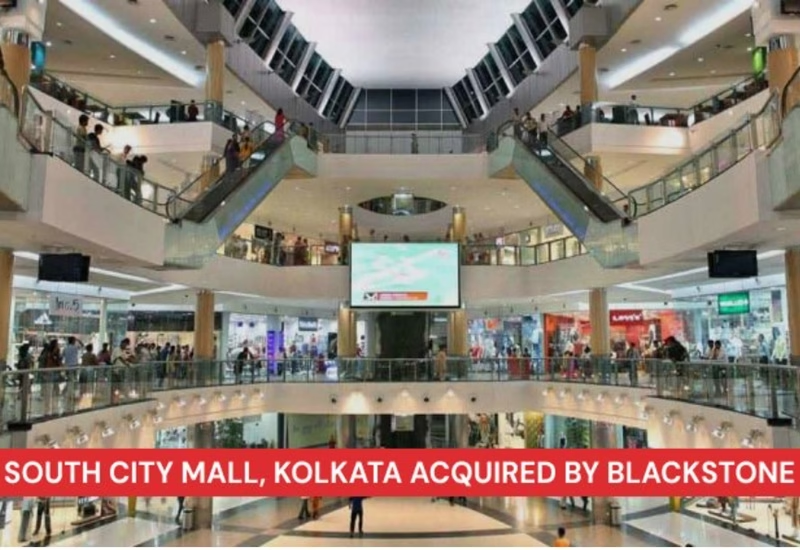
In one of the largest retail real estate deals of the year, Blackstone Group has acquired South City Mall, Kolkata’s premier shopping destination, for approximately ₹3,250 crore. The deal marks Blackstone’s first significant retail investment in Eastern India, expanding its already substantial footprint in the country’s organised retail sector. While there’s no official confirmation yet of its inclusion in the Nexus Select Trust portfolio, previous Blackstone acquisitions in India — including Select Citywalk, Elante, and the Prestige malls — were eventually consolidated under Nexus. Should the mall be added, Nexus Select Trust’s portfolio would expand to 20 malls across 16 cities, with a total Gross Leasable Area (GLA) of 11.65 million sq. ft. South City Mall: A Retail Landmark Launched in 2008 by a consortium of Kolkata-based developers, South City Mall spans 1 million sq. ft. on Prince Anwar Shah Road. Anchored by a mix of premium Indian and international brands, a 1,400-seat food court, and a loyal catchment, the mall reportedly clocks annual turnover of ₹1,800 crore with weekend footfalls exceeding 2 lakh. The asset is expected to benefit from Blackstone’s global retail expertise and operating leverage. Market sources indicate the acquisition was structured through a mix of equity and financing, valuing the mall at a benchmark-setting ₹32,500 per sq. ft. Strategic Implications for Blackstone Eastern Gateway: This marks Blackstone’s first major retail asset in East India. Earlier, in 2018, it had acquired a majority stake in Esplanade One, Bhubaneswar (developed by Forum Group). Top-Tier Asset: South City is among India’s most profitable malls in terms of revenue per sq. ft. REIT Enhancement: The asset is expected to strengthen Nexus Select Trust’s earnings and investor appeal, if included. Long-Term India Bet: This deal aligns with Blackstone’s continued confidence in India’s consumption-led growth trajectory. Nexus Select Trust: Now 20 Malls Strong If South City Mall joins the fold, Nexus Select Trust would have: 20 malls Presence in 16 cities 65 million sq. ft. of GLA Already the largest retail platform in India, Nexus manages a portfolio spanning metros and Tier 2 cities. In FY24–25, it reported 130+ million footfalls, ₹12,400 crore in tenant sales, and 97% occupancy. A REIT With Momentum Under the leadership of Dalip Sehgal, Nexus Select Trust has been reshaping post-pandemic retail in India by focusing on: Experiential formats(entertainment, F&B, co-working) Optimised tenant mix Digitally driven engagement Strong ESG practices With Blackstone’s continued support, Nexus is actively pursuing Tier 1 and high-density Tier 2 city assets, backed by sustainable NOI and consumer loyalty. Outlook: India as a Global Retail Play India’s organised retail footprint is projected to exceed 160 million sq. ft. by 2027, fuelled by urbanisation, rising incomes, and aspirational spending. With the acquisition of South City Mall, Blackstone signals its confidence in East India’s retail potential, while Nexus Select Trust stands poised to further consolidate its position as India’s most balanced and diversified retail platform.
REITs market projected to reach Rs 19.7 tn by 2030, powered by retail, warehousing: Knight Frank India
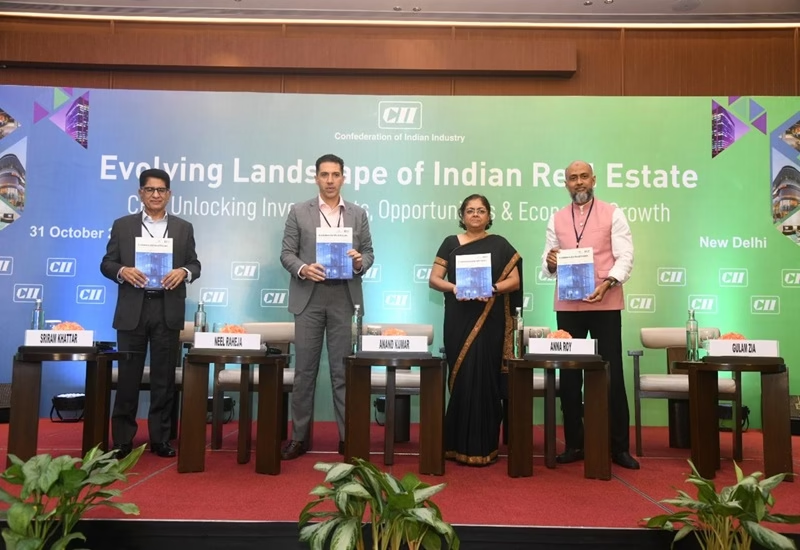
Knight Frank India, in collaboration with the Confederation of Indian Industry (CII), today unveiled its latest report, Commercial Real Estate: Potential is Built, Opportunity is Now, at the CII Conference on Evolving Landscape of Indian Real Estate – CRE: Unlocking Investments, Opportunities & Economic Growth. The report positions India’s commercial real estate (CRE) sector at a defining juncture, where its built potential is set to translate into tangible growth. Among its key highlights, India’s REIT market is projected to reach INR 19.7 tn by 2030 (from INR 10.4 tn in 2025), driven by high occupancy, favourable taxation, and broader sectoral inclusion. Private equity participation, rising from USD 500 mn in 2011 to multi-billion-dollar highs by 2019, has enhanced transparency, deepened institutional confidence, and paved the way for REIT expansion across India’s thriving CRE landscape. As urbanisation, technology, and progressive policy reforms continue to reshape the sector, India’s CRE stands poised to unlock the next wave of opportunity across asset classes. Retail consumption across the organised formats is estimated at a value of INR 8.8 Tn for FY 2025. Led by shopping centres (INR 4.9 tn), high streets (INR 3.8 tn), and other new-age formats such as airport and transit retail. This expansion reflects a clear shift toward experience-driven, consumer-centric destinations where shopping intersects with lifestyle and leisure. Shishir Baijal, Chairman and Managing Director, Knight Frank India, said, “India’s CRE transformation is being led by businesses that are more global, technology-driven and experience-focused than ever before. Consolidation in office demand, resilient retail growth and the rapid expansion of digital infrastructure have fundamentally reshaped occupier behaviour. Today, companies want efficient, green, future-ready spaces, and capital markets are rewarding that shift. As India heads toward a USD 7 tn economy, CRE will play an essential role in powering productivity, attracting investment and building next-generation urban centres.” REITs: Deepening Market Participation India’s REITs have a potential to diversify beyond traditional asset classes like office, retail, and warehousing, to industrial parks, data centres, and hospitality. Listed REITs have delivered stable average annual dividend yield of about 5.5%, making them attractive income-generating vehicles. By 2030, India’s REIT market (including office, retail and warehousing sectors) is projected to reach INR 19.7 tn. India currently has five listed REITs covering about 177 mn sq ft of commercial and retail space spanning operational, under-construction, and upcoming assets worth approximately INR 2.3 tn with over 290,000 unitholders. Office REITs India’s office REITs account for just 15.3% of the total office stock across the top eight cities[1], signalling strong potential for institutional growth. Demand from Global Capability Centres (GCCs) and India-facing businesses continues to strengthen, supported by a steady leasing pipeline and occupier preference for premium, sustainable workspaces. The value of REIT-able office assets is expected to rise from INR 8.2 tn in 2025 to INR 16.0 tn by 2030, nearly doubling in five years. With substantial prime office assets yet to enter REIT structures, broader participation from developers and investors will define the next growth phase for India’s office REIT market. Retail REITs Retail REITs are emerging as a new frontier for India’s real estate market amid a strong revival in organized retail. With only 7.3 mn sq ft of Grade A stock currently under REITs, out of a total of 66 mn sq ft of Grade A stock, there is significant headroom for institutional expansion. The value of REIT-able retail assets is projected to grow from INR 1.5 tn in 2025 to INR 2.4 tn by 2030, driven by rising consumer demand and the shift toward formal retail formats. As malls, lifestyle hubs, and mixed-use developments proliferate, retail REITs offer a structured, transparent way for investors to participate in India’s consumption-led growth story. Warehousing and Industrial REITs Warehousing has emerged as one of the most promising future avenues for REITs in India. Fuelled by e-commerce and third-party logistics (3PL) growth, leasing activity reached 32.1 mn sq ft in H1 2025. The top eight warehousing markets collectively hold 220.9 mn sq ft of Grade A stock, offering vast institutional potential. As technology-enabled, high-quality logistics facilities gain traction among occupiers, industrial and warehousing REITs or InvITs are expected to be launched in the next few years. Value of REIT/InvIT can potentially grow from INR 0.7 tn to INR 1.3 tn by 2030. Neel Raheja, Chair, CII National Committee on Real Estate & Housing, and Group President, K Raheja Corp, said, “The partnership between CII and Knight Frank underscores a shared commitment to advancing India’s built environment. As commercial real estate matures, it will play a pivotal role in shaping investment flows, employment, and urban transformation. The sector’s progress mirrors India’s broader economic journey—where potential is abundant, and the time to seize opportunity is now.” Office: Navigating Supply Constraints and Unlocking Growth India is world’s fourth largest office market (valued at INR 16.4 tn (USD 186 bn) and now it has crossed the 1 bn sq ft milestone in 2025. Over two decades, office stock expanded at a CAGR of 8.6%, underscoring structural resilience and sustained investor appetite. Between 2008 and 2024, gross leasing activity grew 5% CAGR, while new completions rose just 1%, tightening the supply-to-demand ratio from 1.40 in 2008 to 0.49 in 2025. The report notes that several top developers have shifted focus to residential projects for higher margins and quicker returns, deepening supply constraints. To achieve the next milestone of 2 bn sq ft, India’s office sector must blend expansion with optimisation through policy incentives, public-private partnerships/JVs and institutional capital. Integrating green certifications early in the planning process is increasingly seen as best practice, enhancing ESG alignment and unlocking additional FSI. Notably, 31% of existing office stock offers retrofitting potential, while 12% of SEZ assets can be adaptively reused, creating scope for sustainable growth. Retail: Experience, Scale, and Renewed Investor Confidence Across organised formats, retail consumption is estimated at a value of INR 8.8 tn for FY 2025, driven by the expansion of shopping centres, high streets, and emerging formats such as airport and transit retail. Since
Nexus Select Trust’s Retail Revolution

Behind the Scenes of India’s Largest Consumption Platform – Vision, Velocity, and the Next Phase of Growth At the Capital Markets Day hosted by Nexus Select Trust, a spirited fireside chat brought together three of India’s most influential minds in real estate: Anuj Puri, Chairman of Anarock Group; Tuhin Parikh, Senior Managing Director at Blackstone; and Arjun Sharma, Vice Chairman of Nexus Select Trust and Chairman of Select Infrastructure. With humour, history, and high conviction, the trio peeled back the layers of what powers India’s largest retail consumption platform. From a Mall to a Movement: The Genesis of Nexus Tuhin Parikh shared the strategic roots of Nexus Select Trust with characteristic candour: “There wasn’t some grand vision. Blackstone believes in doing few things, but going deep and doing them at scale. That was the thinking.” Having seen the durability of location-led retail through his early days, Parikh was convinced that retail in India could be resilient and scalable. The first step came in 2016 with the acquisition of Amritsar’s AlphaOne mall. What followed was a blistering pace of platform-building, thanks to a core belief: great assets need great operators. The Power of Partnership For Arjun Sharma, aligning Select CITYWALK — India’s most iconic mall — with Nexus was both strategic and philosophical. “When you have a partner like Blackstone, with deep respect for colleagues and partners, the decision is easy. Nexus’s platform allowed us to monetize while becoming part of something much larger. And Nexus’s playbook on acquisitions is just stellar,” Sharma said. He underscored that consumption centres like Select are no longer just malls, but emotion-led ecosystems with marketing, footfall management, and lifestyle curation at their core. Buy or Build? A Case for Strategic Acquisition When asked about the ‘build vs. buy’ dilemma, Sharma noted: “If you’re looking at a 10 year return window, development and acquisition yield roughly the same IRR. But acquisitions de-risk the timeline and regulatory uncertainty. And with our team’s expertise, we can turn around underperforming malls in 12-18 months with 20%+ IRR gains.” He cited Nexus’s recent acquisition of Vega City Mall in Bangalore and its exponential post-acquisition growth as proof of the model. Why India’s Retail Real Estate is Different Parikh highlighted the distinctiveness of Indian retail from its global peers. “In the West, malls are utilitarian. In India, they’re cultural hubs. Our malls are more infill, experience-driven, and cashflow positive. This isn’t just about square feet. It’s about purpose,” he said. He also pointed out that while global investors were wary of retail post-2010, India’s demographic dividend and urban consumption behaviour presented a compelling counter-narrative. Why REITs are the Future As a pioneer of REITs in India, Parikh believes their best days are ahead. “REITs offer liquidity, transparency, tax-free dividend flows, and are easier for generational wealth transfer. No small office or shop can compete with that,” he said. Currently there are four REITs with 1 more launching soon, Blackstone is all-in on this asset class. Tier 2–Tier 3: India’s Real Growth Engines Sharma highlighted how smaller cities are outperforming expectations. “Bhubaneswar’s Esplanade Mall has seen double digit CAGR over 5 years. Ludhiana sells the most Mercedes per capita. We’re seeing Zara and H&M keen to enter these markets through our platform,” he said. Parikh recalled initial doubts during the Bhubaneswar deal, only to watch the asset become one of the top performers in the Nexus portfolio. The Most Involved Asset Class While Parikh manages offices, hotels, logistics and retail assets, he admits retail is the most engaging. “Logistics is passive. Hotels are intensive but third-party managed. Retail? It’s a living animal. You innovate daily — from events to marketing revenue to tenant mix. Five years ago, we had zero in marketing income. Today, it’s over Rs. 100 crore,” he revealed. Sharma added: “Which other business gives you 75% gross operating profit? And that too with multiple income streams beyond rent — from events to brand launches to ad revenue.” Long-Term Parentage and the Future of Nexus Will Blackstone remain a long-term parent? “That depends,” said Parikh. “But whether we hold it forever or not, the foundation is built to last. The moat is real, the team is unmatched, and innovation is constant. Anyone who tries to replicate this will have to go through years of pain we’ve already endured.” Sharma added: “We’ve only increased our shareholding since listing. And I’ve told Tuhin, I want him to be Chairman forever.” Rapid Fire with Retail Titans One city ready to explode? “Gurgaon, Navi Mumbai, and southern tech hubs,” said Sharma. One global brand you want tomorrow? “We brought Apple. Next? Harrods or Galeries Lafayette.” One Indian mall outside Nexus you admire? “Phoenix Parel, for their ability to innovate and hold the moat for decades,” said Parikh. Biggest strength of Nexus? “Energy,” said Parikh. “People,” added Sharma. Conclusion: The Nexus Thesis If one word defined the chat, it was “passion.” Whether it’s Blackstone’s scale philosophy, Sharma’s wisdom garnered by running India’s most successful mall, or Nexus’s exponential ambitions, one thing is clear: India’s retail renaissance is being shaped not just by capital and catchments, but by conviction. And in that conviction, Nexus Select Trust is not just running malls. It’s building India’s consumption future.