
Shopping Centres Next 2025: Recode the Mall — Purpose, People, Possibility Redefine India’s Retail Future
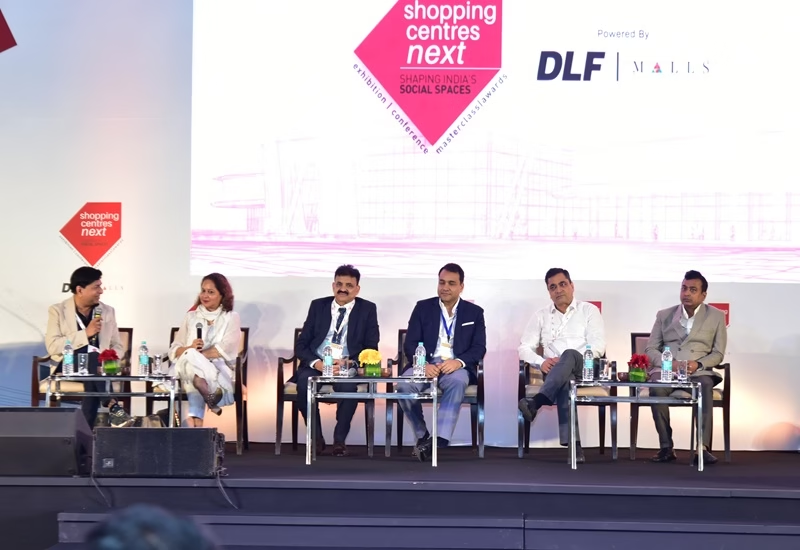
Held over two days at the Grand Hyatt (July 23–24), the event welcomed 500+ professionals, 200+ brands, 100+ speakers, and more than 10 powerful sessions—all exploring the central theme: “What’s Next for India’s Malls?” Goa: The retail real estate industry came together in Goa for one of its most forward-looking events—Shopping Centres Next (SCN) 2025. Hosted by the IMAGES Group, SCN has cemented its reputation as India’s leading platform for stakeholders across the shopping centre ecosystem. Held over two days at the Grand Hyatt (July 23–24), the event welcomed 500+ professionals, 200+ brands, 100+ speakers, and more than 10 powerful sessions—all exploring the central theme: “What’s Next for India’s Malls?” Discussions were driven by key trends, including the rise of Tier 2/3 markets, institutionalisation of retail assets, AI-powered retail planning, and the evolving role of malls in the digital era. This edition spotlighted a critical shift: malls are no longer just shopping hubs—they are evolving into immersive, cultural, and community-centric environments. The agenda reflected this transformation, with deep dives into changing consumer behaviour, technological advancements, innovative design, sustainable practices, and new economic models shaping the future of retail real estate. In his welcome address, Vineet Chadha, COO – Retail, IMAGES Group, set the tone for the event by highlighting the urgency of reinvention. “SCN 2025 is about shaping shopping centres into iconic lifestyle and social destinations. Thank you to DLF Malls and all our partners for supporting this vision. Together in Goa, we celebrate the power of experience, engagement, and imagination to redefine the future of India’s cities and retail.” The event’s inaugural session—“Recode the Mall: Purpose, People, Possibility”—brought together some of India’s most forward-thinking leaders in mall development and investment. Discussions focused on how malls can move beyond footfalls and rentals to become immersive, multifunctional destinations that resonate with today’s and tomorrow’s consumers. Pushpa Bector, Sr. Executive Director & Business Head, DLF Retail, emphasised a consumer-first approach to mall creation, “Mall development today is both an art and a science. At DLF, we begin every project with a deep understanding of consumer catchments, brand preferences, and behavioural data. From connectivity to sustainability, every element is engineered for experience. Mixed-use formats are the future, and the customer remains at the heart of every decision.” Abhishek Bansal, Executive Director, Pacific Group, added, “Designing and managing malls around ‘experience per square foot’ has been a proven formula for us. It’s not just about retail; it’s about creating emotionally resonant environments built on the right brand mix, insights, and culture.” Rajneesh Mahajan, CEO, Inorbit Malls, reflected on the blurring boundaries between asset classes and the growing role of design and service. “As mall developers, we now focus on three key pillars—strategic positioning, operational excellence, and design aesthetics. Today, a mall must offer more than functionality; it must inspire and connect. With infrastructure and lifestyle converging, customer experience becomes the key differentiator.” Other sessions, including “Beyond Brick & Mortar: The Future of Shopping Centres” and “Shared Goals, Shared Growth: The New Mall–Retail Equation,” showcased how retail real estate must align with digital evolution and collaborative growth models. The latter session, in particular, explored how the outdated landlord–tenant mindset is being replaced with performance-based, empathy-driven partnerships between malls and brands. The session “Connected Commerce: From Browsers to Buyers in a Seamless Retail World” explored how malls are evolving beyond traditional physical formats to become integral players in the omnichannel retail ecosystem. The discussion focused on how malls can adopt integrated strategies to bridge the digital–physical divide and drive seamless consumer experiences. “While the industry continues to discuss omnichannel strategies, true implementation remains complex and evolving,” said Rehan Huck, VP & Head – Leasing, DLF Shopping Malls. “There are valid concerns from developers around reporting accuracy, POS integration, and ensuring physical stores don’t become mere fulfilment hubs. However, we believe that bridging the digital–physical divide is inevitable and accelerating faster than expected. At DLF, we’ve invested heavily in robust loyalty and tech systems that seamlessly connect multiple malls and consumer touchpoints. While there’s still grey space to navigate, integrated strategies are showing promise, and long-term coexistence is both possible and necessary.” “Today, malls aren’t just about driving footfall—they’re about attracting relevant footfall,” said Sameer Verma, General Manager, Lulu Mall Lucknow.“The focus is on identifying and engaging the right customers through targeted strategies. At Lulu, our loyalty programme ‘Lulu Happiness,’ with 2.6 million users, gives us deep insights into consumer behaviour—what they buy, when, and from whom. This data allows us to run highly focused campaigns and category promotions. By integrating technology and collaborating with brands on shared insights, we’re bridging the digital–physical divide and creating measurable, meaningful engagement that benefits both retailers and consumers.” The session “From Empty Units to Engaged Spaces – Reactivating Underperforming Zones in Shopping Centres” addressed the ongoing challenge of vacant or low-performing areas within malls. It explored actionable solutions for transforming these underutilised spaces into vibrant, revenue-generating zones. Discussions centred around innovative approaches such as short-term activations, adaptive reuse, and creative tenant mix strategies—all aimed at boosting footfall, driving engagement, and enhancing the overall customer experience. SCN 2025 also provided attendees a platform to explore cutting-edge innovations—from AI-powered space planning and sustainable construction models to urban integration strategies and phygital engagement tools. Across all sessions, one idea echoed strongly: malls must embed themselves into the cultural and social fabric of the cities they inhabit. With representation from top mall operators, real estate investors, retail CEOs, architects, urban planners, and technology providers, SCN 2025 has set the stage for a collaborative, future-forward vision of India’s shopping centre evolution.