
India’s Retail Leasing Rises Sharply in 2025 Driven by Higher Supply and Store Expansion

India’s retail leasing rose sharply in 2025, reaching between 8.9 million and 12.5 million sq. ft, the highest level in three years. This marked a year-on-year increase of over 50% compared to 2024, supported by higher retail completions and continued store expansion by brands across major cities. Supply Sees Sharp Increase Fresh retail supply during the year ranged between 4.3 million and 6.3 million sq. ft. Hyderabad accounted for more than half of the new additions, followed by Mumbai and Delhi NCR. Delhi NCR, Hyderabad and Mumbai together saw the opening of 15 new shopping malls in 2025. By the end of the year, mall stock across the top seven cities stood close to 92 million sq. ft. In the second half of 2025, around 2.1 million sq. ft of new space became operational, while leasing absorption reached nearly 5.6 million sq. ft. Hyderabad, Delhi NCR and Bengaluru Lead Leasing Leasing activity was led by Hyderabad, Delhi NCR and Bengaluru. One estimate showed Delhi NCR and Bengaluru accounting for 24% each of total leasing, followed by Hyderabad at 23%. Another placed Hyderabad at the top with a 34% share, followed by Delhi NCR at 20% and Chennai at 16%. Mumbai contributed about 17%, while Chennai, Kolkata and Pune recorded lower shares due to limited new supply. Malls and High Streets Account for Most Leasing Shopping malls accounted for about 45% of total leasing, while high streets captured around 48%. In Delhi NCR and Hyderabad, malls were the preferred format, while high-street locations dominated leasing in Bengaluru. Ankit Sharma, SVP-Leasing, Elan Group said, “With India crossing nearly 9 million square feet of leasing in 2025 and a 45 percent rise in the July to September quarter alone to 2.41 million square feet, the strength of the retail leasing market is clearly reflected in the numbers and demand has remained strong across both malls and high streets. Malls are benefiting from well-planned retail formats, fresh supply and growing interest in larger, while established high streets continue to attract brands due to their steady footfall, visibility and close proximity to residential catchments. Brands are building their presence across both formats, indicating a stable and mature phase of expansion for the retail real estate market. This balanced performance shows that the growth of physical retail is becoming more structured and evenly spread.” Fashion, F&B and Jewellery Drive Demand Fashion and apparel remained the largest category, accounting for 34% to 48% of total leasing. Store launches included sustainable labels, streetwear, ethnic wear, athleisure, luxury and D2C brands. Food and beverage (F&B) was the second-largest contributor, with a 12% to 20% share. Brands preferred large-format outlets in malls and prominent high-street locations. Jewellery followed with an 8% share, supported by expansion from lab-grown diamond brands. Girish Kamble, CEO- West, Tribeca Developers “India’s retail sector continues to demonstrate strong momentum, driven by robust leasing activity and sustained expansion from both domestic and global brands. What’s especially encouraging is the growing demand for modern, branded, and experiential retail environments – formats that elevate convenience, curation, and consumer engagement. We believe the market is now firmly ready for branded retail and premium commercial destinations, particularly in the luxury segment. This aligns strongly with our own development philosophy at Tribeca, where we are creating next-generation commercial spaces designed for global brands, aspirational consumers, and the future of urban retail. The shift is clear: India is ready – and rising – to embrace world-class retail real estate.” D2C Brands Increase Offline Presence D2C brands contributed about 0.9 million sq. ft of total leasing and recorded 48% year-on-year growth. Another estimate showed D2C brands accounting for 27% of total leasing in 2025. Institutional-Grade Mall Stock Institutionally owned or premium single-owner malls account for about 44% of total mall stock across the top seven cities. Technology and Entertainment Zones Retailers used tools such as virtual try-ons, generative styling platforms and predictive inventory models. Entertainment zones in malls used formats such as edutainment, virtual reality and RFID-based loyalty systems. These zones enabled the use of large interior spaces and supported higher rentals for adjoining F&B outlets, along with longer lease tenures. Retail Space Under Construction More than 47 million sq. ft of retail space is under construction and is expected to be operational by 2030. Nearly 20 million sq. ft of this upcoming supply is classified as premium-grade.
REITs market projected to reach Rs 19.7 tn by 2030, powered by retail, warehousing: Knight Frank India
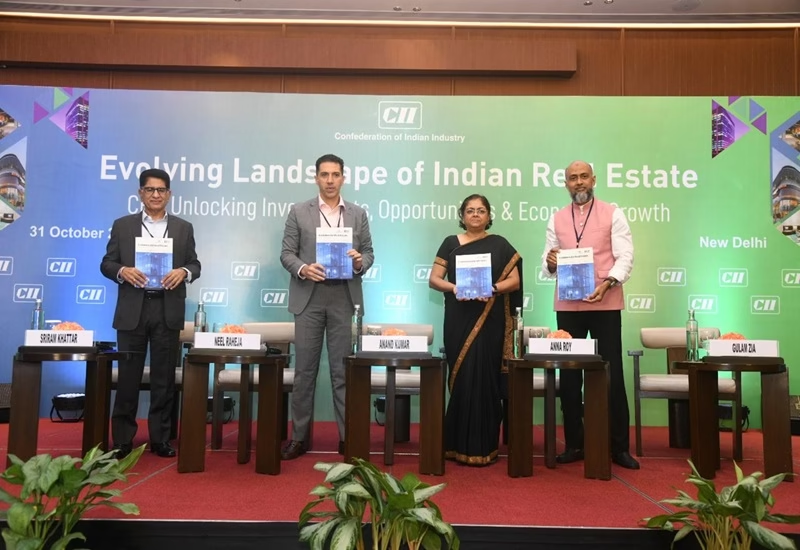
Knight Frank India, in collaboration with the Confederation of Indian Industry (CII), today unveiled its latest report, Commercial Real Estate: Potential is Built, Opportunity is Now, at the CII Conference on Evolving Landscape of Indian Real Estate – CRE: Unlocking Investments, Opportunities & Economic Growth. The report positions India’s commercial real estate (CRE) sector at a defining juncture, where its built potential is set to translate into tangible growth. Among its key highlights, India’s REIT market is projected to reach INR 19.7 tn by 2030 (from INR 10.4 tn in 2025), driven by high occupancy, favourable taxation, and broader sectoral inclusion. Private equity participation, rising from USD 500 mn in 2011 to multi-billion-dollar highs by 2019, has enhanced transparency, deepened institutional confidence, and paved the way for REIT expansion across India’s thriving CRE landscape. As urbanisation, technology, and progressive policy reforms continue to reshape the sector, India’s CRE stands poised to unlock the next wave of opportunity across asset classes. Retail consumption across the organised formats is estimated at a value of INR 8.8 Tn for FY 2025. Led by shopping centres (INR 4.9 tn), high streets (INR 3.8 tn), and other new-age formats such as airport and transit retail. This expansion reflects a clear shift toward experience-driven, consumer-centric destinations where shopping intersects with lifestyle and leisure. Shishir Baijal, Chairman and Managing Director, Knight Frank India, said, “India’s CRE transformation is being led by businesses that are more global, technology-driven and experience-focused than ever before. Consolidation in office demand, resilient retail growth and the rapid expansion of digital infrastructure have fundamentally reshaped occupier behaviour. Today, companies want efficient, green, future-ready spaces, and capital markets are rewarding that shift. As India heads toward a USD 7 tn economy, CRE will play an essential role in powering productivity, attracting investment and building next-generation urban centres.” REITs: Deepening Market Participation India’s REITs have a potential to diversify beyond traditional asset classes like office, retail, and warehousing, to industrial parks, data centres, and hospitality. Listed REITs have delivered stable average annual dividend yield of about 5.5%, making them attractive income-generating vehicles. By 2030, India’s REIT market (including office, retail and warehousing sectors) is projected to reach INR 19.7 tn. India currently has five listed REITs covering about 177 mn sq ft of commercial and retail space spanning operational, under-construction, and upcoming assets worth approximately INR 2.3 tn with over 290,000 unitholders. Office REITs India’s office REITs account for just 15.3% of the total office stock across the top eight cities[1], signalling strong potential for institutional growth. Demand from Global Capability Centres (GCCs) and India-facing businesses continues to strengthen, supported by a steady leasing pipeline and occupier preference for premium, sustainable workspaces. The value of REIT-able office assets is expected to rise from INR 8.2 tn in 2025 to INR 16.0 tn by 2030, nearly doubling in five years. With substantial prime office assets yet to enter REIT structures, broader participation from developers and investors will define the next growth phase for India’s office REIT market. Retail REITs Retail REITs are emerging as a new frontier for India’s real estate market amid a strong revival in organized retail. With only 7.3 mn sq ft of Grade A stock currently under REITs, out of a total of 66 mn sq ft of Grade A stock, there is significant headroom for institutional expansion. The value of REIT-able retail assets is projected to grow from INR 1.5 tn in 2025 to INR 2.4 tn by 2030, driven by rising consumer demand and the shift toward formal retail formats. As malls, lifestyle hubs, and mixed-use developments proliferate, retail REITs offer a structured, transparent way for investors to participate in India’s consumption-led growth story. Warehousing and Industrial REITs Warehousing has emerged as one of the most promising future avenues for REITs in India. Fuelled by e-commerce and third-party logistics (3PL) growth, leasing activity reached 32.1 mn sq ft in H1 2025. The top eight warehousing markets collectively hold 220.9 mn sq ft of Grade A stock, offering vast institutional potential. As technology-enabled, high-quality logistics facilities gain traction among occupiers, industrial and warehousing REITs or InvITs are expected to be launched in the next few years. Value of REIT/InvIT can potentially grow from INR 0.7 tn to INR 1.3 tn by 2030. Neel Raheja, Chair, CII National Committee on Real Estate & Housing, and Group President, K Raheja Corp, said, “The partnership between CII and Knight Frank underscores a shared commitment to advancing India’s built environment. As commercial real estate matures, it will play a pivotal role in shaping investment flows, employment, and urban transformation. The sector’s progress mirrors India’s broader economic journey—where potential is abundant, and the time to seize opportunity is now.” Office: Navigating Supply Constraints and Unlocking Growth India is world’s fourth largest office market (valued at INR 16.4 tn (USD 186 bn) and now it has crossed the 1 bn sq ft milestone in 2025. Over two decades, office stock expanded at a CAGR of 8.6%, underscoring structural resilience and sustained investor appetite. Between 2008 and 2024, gross leasing activity grew 5% CAGR, while new completions rose just 1%, tightening the supply-to-demand ratio from 1.40 in 2008 to 0.49 in 2025. The report notes that several top developers have shifted focus to residential projects for higher margins and quicker returns, deepening supply constraints. To achieve the next milestone of 2 bn sq ft, India’s office sector must blend expansion with optimisation through policy incentives, public-private partnerships/JVs and institutional capital. Integrating green certifications early in the planning process is increasingly seen as best practice, enhancing ESG alignment and unlocking additional FSI. Notably, 31% of existing office stock offers retrofitting potential, while 12% of SEZ assets can be adaptively reused, creating scope for sustainable growth. Retail: Experience, Scale, and Renewed Investor Confidence Across organised formats, retail consumption is estimated at a value of INR 8.8 tn for FY 2025, driven by the expansion of shopping centres, high streets, and emerging formats such as airport and transit retail. Since