
India’s GCC count set to surpass 2,400 by 2030 as commercial real estate hits record highs

India’s Global Capability Centres are poised to exceed 2,400 by 2030, employing more than 2.8 million professionals, as the country’s commercial real estate sector records its strongest performance despite global economic headwinds, according to a new industry report. The findings, published in the FICCI-ANAROCK report “Workplaces 2025: India Commercial Real Estate Reimagined,” reveal that GCCs now account for more than 40 per cent of total gross office leasing across India’s top seven cities, cementing their position as structural anchors of the country’s property market. As of end-2024, India housed over 1,700 GCCs employing more than 1.9 million professionals. The sector’s market size has more than doubled from USD 30 billion in 2019 to approximately USD 64 billion in 2024, with projections indicating growth to USD 105–110 billion by 2030 at a compound annual growth rate of 10 per cent. The expansion is being driven by sustained demand from IT-ITeS, banking and financial services, healthcare and life sciences, and engineering research and development sectors, alongside India’s cost efficiency and deep talent pools. Raj Menda, Chairman of the FICCI Committee on Urban Development and Real Estate and Chairman of the Supervisory Board, RMZ Corporation, said: “India’s commercial real estate sector is at a pivotal inflection point. Record office demand underscores a decisive shift toward high-quality, flexible, and technology-led assets. Global Capability Centres have emerged as a structural anchor of this growth, fundamentally reshaping office demand and accelerating the development of premium, future-ready workplaces across both established and emerging cities.” Bengaluru continues to dominate India’s GCC landscape, hosting more than 875 centres—representing 29 per cent of the national total. The city captured over one-third of India’s GCC leasing in 2025, followed by Pune at 15 per cent, with Delhi-NCR and Hyderabad each accounting for 14 per cent. Notably, GCC operations are expanding beyond established metros into Tier 2 cities. Jaipur, Kochi, Indore, Surat, and Coimbatore are emerging as the next wave of GCC destinations, reflecting broader geographical diversification of India’s knowledge economy. Office leasing across the top seven cities reached approximately 80.5 million square feet in 2025, with GCCs accounting for 32.5 million square feet. Grade A office stock in these markets touched nearly 800 million square feet, led by Bengaluru and the National Capital Region, which together comprise nearly half of total supply. The report also highlights the structural transformation underway in India’s Real Estate Investment Trust segment. With five listed REITs commanding a market capitalisation of nearly USD 18 billion, the sector has democratised property investment for retail participants. However, REITs currently represent just 20 per cent of institutional real estate—significantly below mature markets such as the United States, Singapore, and Japan. Of approximately 520 million square feet of REIT-worthy office stock, only 165 million square feet is presently listed, indicating substantial headroom for institutionalisation. The report projects REIT penetration could rise to 25–30 per cent by 2030, driven by diversification into data centres, logistics parks, and retail assets. Menda added: “Sustaining this momentum will require consistent policy support, long-term institutional capital, and continued collaboration between industry and government.” Foreign direct investment inflows rose to a provisional USD 81.04 billion in FY 2024-25, marking a 14 per cent increase from the previous year and underscoring India’s continued appeal as a preferred investment destination. With favourable government policies, proactive state-level GCC frameworks, and office demand increasingly diversified across co-working, BFSI, consultancy, and manufacturing sectors, the outlook for India’s commercial real estate market remains decidedly positive.
6 parks planned to position Maharashtra as Technical Textile leader: Minister Sanjay Savkare
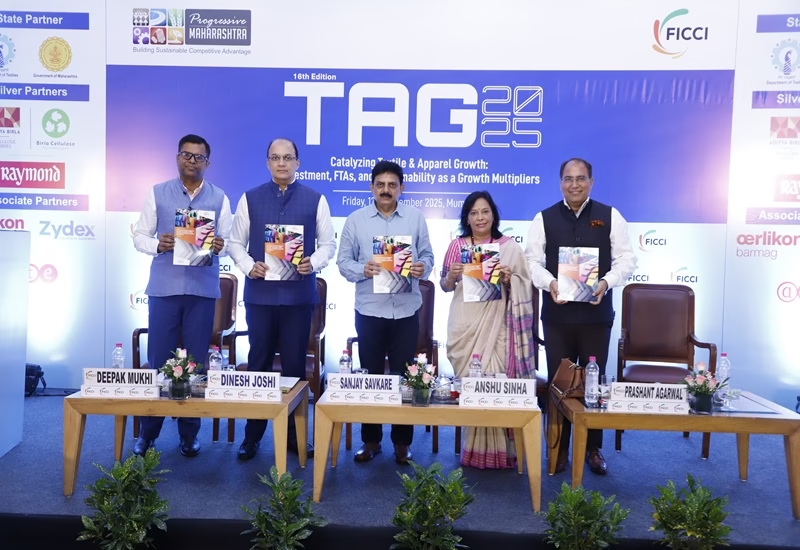
Sanjay Savkare, Minister of Textiles, Government of Maharashtra said that the Maharashtra Government, through its policy measures, is focusing on attracting domestic and foreign investment and providing support on skilling, R&D and infrastructure development to build globally competitive textile & apparel industry in the state. He stated that authorities are working towards establishing 6 technical textile parks, one in each of the revenue divisions, to make Maharashtra a hub for Technical Textiles. Speaking at a FICCI event, Sanjay Savkare added that state has set up a task force to seek suggestions from stakeholders to enhance the export competitiveness of Maharashtra as well as gain suggestions on the support that the Textile Industry can expect. The event saw the release of the FICCI–Wazir Advisors Textile industry report, ‘Catalysing Textile & Apparel Growth: Leveraging Global Opportunities’. Anshu Sinha, Principal Secretary (Textile), Government of Maharashtra also spoke on the need for collaboration and collective efforts of industry, academia and government to further strengthen Maharashtra’s position as a leading textile manufacturing hub, while seeking support of the industry in the areas of skilling, R&D and sustainable practices. Prashant Agarwal, Joint MD, Wazir Advisors shared a brief overview of FICCI – Wazir Advisors Report, which takes stock of the global and Indian textile & apparel (T&A) landscape in a year marked by geopolitical uncertainty, shifting trade flows, rapid advances in sustainability and innovation, and the challenges arising from the US reciprocal tariff scenario. The report also talks about what strategies India can adopt to fully realize its potential and position itself as a leading global hub. The report states that Global textile & apparel trade reached ~US$ 893 billion in 2024, reflecting 5% growth over the previous year, with China retaining one-third share. The global apparel market, now at US$ 1.8 trillion, is projected to touch US$ 2.3 trillion by 2030. India, with a US$ 184 billion domestic T&A market and US$ 37 billion in exports (FY25), continues to hold strong fundamentals but faces challenges from newly imposed US tariffs of 50%, compared to lower rates for competitors like Bangladesh and Vietnam. The report identifies garmenting investments as the central lever for India’s next phase of growth, supported by FDI inflows, global alliances, and government schemes like PLI and PM MITRA Parks. It highlights how forward integration into apparel manufacturing can enhance value addition, create large-scale employment, and improve India’s competitiveness as an end-to-end sourcing hub. It also emphasises innovation and sustainability as twin imperatives—ranging from smart textiles, eco-friendly materials, and digitalized supply chains to scalable adoption of green manufacturing practices. It further underlines India’s factor cost advantages over peers, while cautioning that weak R&D and lack of FTAs with key markets remain bottlenecks. The way forward, according to the whitepaper, rests on market diversification beyond the US, policy stability, infrastructure development, R&D and skilling, and embedding sustainability across the value chain. By combining investment-led growth with innovation and global partnerships, India can not only withstand tariff headwinds but also position itself as a leading global sourcing destination by 2030.