
REITs market projected to reach Rs 19.7 tn by 2030, powered by retail, warehousing: Knight Frank India
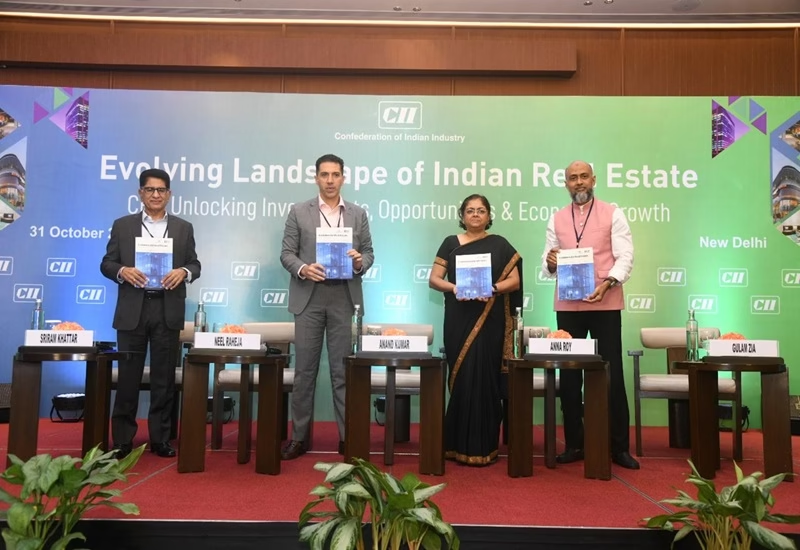
Knight Frank India, in collaboration with the Confederation of Indian Industry (CII), today unveiled its latest report, Commercial Real Estate: Potential is Built, Opportunity is Now, at the CII Conference on Evolving Landscape of Indian Real Estate – CRE: Unlocking Investments, Opportunities & Economic Growth. The report positions India’s commercial real estate (CRE) sector at a defining juncture, where its built potential is set to translate into tangible growth. Among its key highlights, India’s REIT market is projected to reach INR 19.7 tn by 2030 (from INR 10.4 tn in 2025), driven by high occupancy, favourable taxation, and broader sectoral inclusion. Private equity participation, rising from USD 500 mn in 2011 to multi-billion-dollar highs by 2019, has enhanced transparency, deepened institutional confidence, and paved the way for REIT expansion across India’s thriving CRE landscape. As urbanisation, technology, and progressive policy reforms continue to reshape the sector, India’s CRE stands poised to unlock the next wave of opportunity across asset classes. Retail consumption across the organised formats is estimated at a value of INR 8.8 Tn for FY 2025. Led by shopping centres (INR 4.9 tn), high streets (INR 3.8 tn), and other new-age formats such as airport and transit retail. This expansion reflects a clear shift toward experience-driven, consumer-centric destinations where shopping intersects with lifestyle and leisure. Shishir Baijal, Chairman and Managing Director, Knight Frank India, said, “India’s CRE transformation is being led by businesses that are more global, technology-driven and experience-focused than ever before. Consolidation in office demand, resilient retail growth and the rapid expansion of digital infrastructure have fundamentally reshaped occupier behaviour. Today, companies want efficient, green, future-ready spaces, and capital markets are rewarding that shift. As India heads toward a USD 7 tn economy, CRE will play an essential role in powering productivity, attracting investment and building next-generation urban centres.” REITs: Deepening Market Participation India’s REITs have a potential to diversify beyond traditional asset classes like office, retail, and warehousing, to industrial parks, data centres, and hospitality. Listed REITs have delivered stable average annual dividend yield of about 5.5%, making them attractive income-generating vehicles. By 2030, India’s REIT market (including office, retail and warehousing sectors) is projected to reach INR 19.7 tn. India currently has five listed REITs covering about 177 mn sq ft of commercial and retail space spanning operational, under-construction, and upcoming assets worth approximately INR 2.3 tn with over 290,000 unitholders. Office REITs India’s office REITs account for just 15.3% of the total office stock across the top eight cities[1], signalling strong potential for institutional growth. Demand from Global Capability Centres (GCCs) and India-facing businesses continues to strengthen, supported by a steady leasing pipeline and occupier preference for premium, sustainable workspaces. The value of REIT-able office assets is expected to rise from INR 8.2 tn in 2025 to INR 16.0 tn by 2030, nearly doubling in five years. With substantial prime office assets yet to enter REIT structures, broader participation from developers and investors will define the next growth phase for India’s office REIT market. Retail REITs Retail REITs are emerging as a new frontier for India’s real estate market amid a strong revival in organized retail. With only 7.3 mn sq ft of Grade A stock currently under REITs, out of a total of 66 mn sq ft of Grade A stock, there is significant headroom for institutional expansion. The value of REIT-able retail assets is projected to grow from INR 1.5 tn in 2025 to INR 2.4 tn by 2030, driven by rising consumer demand and the shift toward formal retail formats. As malls, lifestyle hubs, and mixed-use developments proliferate, retail REITs offer a structured, transparent way for investors to participate in India’s consumption-led growth story. Warehousing and Industrial REITs Warehousing has emerged as one of the most promising future avenues for REITs in India. Fuelled by e-commerce and third-party logistics (3PL) growth, leasing activity reached 32.1 mn sq ft in H1 2025. The top eight warehousing markets collectively hold 220.9 mn sq ft of Grade A stock, offering vast institutional potential. As technology-enabled, high-quality logistics facilities gain traction among occupiers, industrial and warehousing REITs or InvITs are expected to be launched in the next few years. Value of REIT/InvIT can potentially grow from INR 0.7 tn to INR 1.3 tn by 2030. Neel Raheja, Chair, CII National Committee on Real Estate & Housing, and Group President, K Raheja Corp, said, “The partnership between CII and Knight Frank underscores a shared commitment to advancing India’s built environment. As commercial real estate matures, it will play a pivotal role in shaping investment flows, employment, and urban transformation. The sector’s progress mirrors India’s broader economic journey—where potential is abundant, and the time to seize opportunity is now.” Office: Navigating Supply Constraints and Unlocking Growth India is world’s fourth largest office market (valued at INR 16.4 tn (USD 186 bn) and now it has crossed the 1 bn sq ft milestone in 2025. Over two decades, office stock expanded at a CAGR of 8.6%, underscoring structural resilience and sustained investor appetite. Between 2008 and 2024, gross leasing activity grew 5% CAGR, while new completions rose just 1%, tightening the supply-to-demand ratio from 1.40 in 2008 to 0.49 in 2025. The report notes that several top developers have shifted focus to residential projects for higher margins and quicker returns, deepening supply constraints. To achieve the next milestone of 2 bn sq ft, India’s office sector must blend expansion with optimisation through policy incentives, public-private partnerships/JVs and institutional capital. Integrating green certifications early in the planning process is increasingly seen as best practice, enhancing ESG alignment and unlocking additional FSI. Notably, 31% of existing office stock offers retrofitting potential, while 12% of SEZ assets can be adaptively reused, creating scope for sustainable growth. Retail: Experience, Scale, and Renewed Investor Confidence Across organised formats, retail consumption is estimated at a value of INR 8.8 tn for FY 2025, driven by the expansion of shopping centres, high streets, and emerging formats such as airport and transit retail. Since
What’s next for India’s malls?

India’s shopping centres are no longer just destinations to buy—they’re destinations to belong. As spaces evolve, so must our imagination India’s shopping centres are evolving at a dramatic pace. No longer just spaces to transact, malls are now experience engines, cultural arenas, social hubs, and data-driven consumption ecosystems. And that’s the story the industry is coming together to explore and co-author at Shopping Centres Next (SCN) 2025, on July 23–24 in Goa. Organised by the IMAGES Group, SCN is India’s most influential forum for modern retail real estate stakeholders. This year’s theme, infused throughout the agenda, is a directional question: What’s next for India’s malls? The answers are emerging from a confluence of trends: rising Tier 2/3 aspirations, the institutionalisation of retail assets, AI-driven retail planning, and a radical redefinition of what it means to be a “mall” in the age of connected commerce. Let’s explore these shifts through a layered narrative inspired by the SCN 2025 agenda. Recode the Mall: Purpose, People, Possibility In this new era, malls must mean more. The old formula of footfalls and floorplates is giving way to climate-conscious architecture, hyperlocal tenant curation, and human-first design. Success Story: DLF Avenue Saket redesigned itself from a retail property into a curated social and cultural space, with art installations, pet-friendly zones, open-air courtyards, and a strong emphasis on F&B. Global Cue: Coal Drops Yard in London redefined mall culture by converting an old industrial warehouse into a high-design retail precinct, where shopping meets storytelling. Next: India’s future malls will need to prioritise ESG metrics, urban integration, and cultural programming to remain relevant. Shared Growth: From Landlords to Partners The landlord-tenant equation is being rewritten. Malls and retailers are increasingly entering co-risk, co-reward agreements driven by mutual performance and shopper-centricity. Case Study: LuLu Mall Lucknow partnered with 40+ tenants on a unified mall-wide festival, which increased weekend footfall by 27% and dwell time by 3x. Case Study: Pacific Malls created a major industry moment by launching the Pacific Festival of Shopping—a multi-city campaign across its properties in Delhi-NCR, Dehradun, and Jaipur. With over ₹2 crore in prize giveaways, curated weekend carnivals, and gamified app integrations for brand discovery, the campaign delivered 30% growth in weekend footfall and heightened brand visibility for over 100 participating retailers. Innovative Trend: Revenue-share leasing models, combined marketing campaigns, and shared customer data platforms. What’s Next: Co-created loyalty programs, unified digital wallets, and deeper brand-mall collaborations on experiential retail. III. Retail as an Asset Class: The Rise of REITs India’s shopping centres are becoming institutional-grade assets. REITs like Nexus Select Trust are proving that malls can be stable, income-generating platforms. Nexus Snapshot: 19 consumption centres 6 million sq ft retail GLA 130 million footfalls 2% occupancy INR 124 Bn tenant sales (FY24–25) Next: Expect consolidation of Grade A malls under REITs, more foreign institutional interest, and capital-backed innovation in mall operations. Beyond Brick & Mortar: Format to Ecosystem Today’s shopping centres aren’t just places to buy—they’re ecosystems that blend retail, dining, co-working, health, and culture. Case Study: Taurus Zentrum, Thiruvananthapuram is India’s first integrated retail destination located inside a tech park. The larger Taurus Downtown development offers over 700,000 sq ft of gross leasable area with retail, potential hospitality space, convention venues, and SEZ/non-SEZ parcels. This pioneering model brings lifestyle and commerce directly into Kerala’s IT corridor, with built-in customer flows from nearby tech campuses and government offices. Case Study: Avenue Mall @ Texvalley, Erode stands out as South India’s first and largest outlet mall, spanning over 500,000 sq ft within the 2 million sq ft Texvalley textile hub. Developed by Beyond Squarefeet, it fuses wholesale strength with aspirational retail, offering factory outlets, regional fashion brands, local artisans, F&B, and entertainment. Its curated Independence Day launch is set to mark a cultural milestone for Tamil Nadu’s Kongu belt and a new benchmark in Tier 3 retail transformation. Case Study: Phoenix Malls activated a mall-wide digital-first experience at Phoenix Mall of Asia in Bengaluru with QR-based rewards, influencer-led soft launches, and a cultural calendar featuring car rallies, stand-up comedy shows, and art installations. The launch phase saw over 20 million digital impressions and a 40% spike in weekday footfall compared to projections. Global Benchmark: Westfield Century City, LA offers valet parking, rooftop lounges, digital concierge, and event programming to enhance lifestyle relevance. Next: Mixed-use destinations will dominate; malls will function like mini-cities. Connected Commerce: From Browsers to Buyers Digital and physical are no longer distinct spheres. Today’s consumer expects to browse online, touch offline, pay anywhere, and receive products everywhere. Example: Inorbit’s e-Shop initiative lets consumers shop from their favourite mall brands online and pick up in store or opt for delivery. Global Trend: Malls offering smart parking, AR navigation, mobile POS, and in-mall app integrations. Next: Shopping centres as omnichannel fulfillment hubs; QR-led discovery in physical aisles; embedded online-to-offline triggers. Reviving the Empty: Activating Underperforming Zones Vacant zones hurt more than just revenue; they impact shopper perception. Leading malls are responding with creative reuse and short-format experimentation. Example: DLF Promenade’s Pop Box model cycles through emerging D2C brands every 30 days, bringing freshness to underused spaces. Next: Expect test zones, pop-up culture, influencer collaborations, and rotating themes to bring vibrancy back to quieter pockets. VII. Move the Market: Shared Consumer Strategy Malls and brands are no longer separate storytellers. Together, they must script narratives that connect emotionally and culturally. Example: Quest Mall Kolkata curates regional food festivals, Bengali indie cinema screenings, and local art to build deep cultural resonance. Trend: Brands creating mall-exclusive SKUs, storytelling-led visual merchandising, and mall-wide thematic events. Next: Mall as cultural platform—one that inspires, not just sells. VIII. The AI Advantage: Precision-Led Planning AI is transforming how shopping centres are built, leased, and managed. From catchment analysis to predictive leasing and tenant rotation, data is now the key tenant. Use Case: Inorbit Malls, in partnership with Waysahead Global, uses AI to predict catchment trends, plan tenant mix, and adjust lease durations. Next: Expect AI-driven mall layouts, heatmaps for dwell zone optimisation, and even tenant scoring models. Retail Architecture as Urban Catalyst Malls are increasingly shaping not just consumption but the very fabric of cities. Architecture, urban design, and